1. Bridezilla Strikes Back!
This Page Was Most Recently Updated: Sunday, July 22nd 2007
Copyright © 2005, 2007 Hy Bender
Email: hy@hyreviews.com
Other Sites:
It was that time of year again...when the summer was taken over by the amazing New York International Fringe Festival. The largest multi-arts festival in North America, this ninth annual FringeNYC offered more than 180 lively productions running from August 12th through August 28th. The festival's shows played simultaneously in 20 Manhattan venues, totaling nearly 1,300 performances.
Why get excited about the Fringe? Because unlike so many commercial productions tailored to inoffensively appeal to mass audiences, Fringe shows tend to be quirky, individual, and passionate. Thanks to the efforts of Producing Artistic Director Elena K. Holy, Administrative Director Shelley Burch, and the other wonderful Fringe staffers and volunteers, the festival virtually shimmers with fresh artistic approaches, a wide range of voices and styles, high energy, and delightful surprises.
While Fringe productions are both low-budget and inexpensive to see ($15 per ticket—and even less if you buy in bulk), the best of them are as fine and memorable as the priciest play. And they're likely to take you to places that no show in midtown ever will. (This was epitomized by a teen visiting the Fringe a few years ago who told wealthy parents trying to lure her uptown, "But I don't want to see a show on Broadway. I want to see something cool.")
There's also more to the Fringe experience than what's being offered on stage. The festival gives you the opportunity to enjoy the people it attracts—which includes some of the most enthusiastic theatre-goers in New York. Talk to people standing in line, chat with the venue directors and volunteers, engage with the hundreds of artists handing out cards to plug their shows—and try to be open to everyone. You may well make some lifelong friends.
Of course, the untamed nature of Fringe shows means they're not for every taste...and in some cases, not for any taste. One of the most exciting aspects of the Fringe is that it positively encourages productions to take huge risks—which inevitably results in some jaw-dropping failures.
A memorable example is a late-night Fringe play I attended with a composer and an actress a couple of years ago. Although the show lasted only an hour, it felt like days...and as soon as we left the theatre, the actress muttered her opinion dazedly in one succinct phrase: "I wanted to kill myself." She repeated this assessment—"I wanted to kill myself"—over and over for the next two blocks, until we finally managed to calm her down. And this production wasn't even the worst at that year's festival...I personally witnessed three others even more mind-wrecking.
On some level, there's a perverse thrill in seeing a show so bad that you can't believe your eyes. But more to the point, falling prey to one of these dark beasts makes you more fully appreciate the productions that are truly great—that accept the Fringe's challenge to take huge risks with brilliance and actually succeed beyond all expectations.
It's the latter that make the festival most worthwhile. And there's a real joy to hunting for these treasures, finding them...and thoroughly enjoying them.
Starting August 12th, the hunt was on.
To take in the fullness of what FringeNYC offers, I've developed a habit of catching lots of its shows—75 in 2002, 77 in 2003, and 66 in 2004. This year, I spent a fair amount of time maintaining this Web site and writing reviews (including three for The New York Times), so managed to get to only 58 shows. However, I saw most of the productions that are generally agreed to be the best of the festival.
Of course, there are a number of other sources of reviews besides this Web site. Most notably, you can find coverage of many of the top FringeNYC shows via The New York Times, which can be read online at www.nytimes.com.
In addition, there's a comprehensive collection of Fringe reviews available via nytheatre.com. Spearheaded by the site's founder, Martin Denton, this is an invaluable resource for learning about every single Fringe production. The only downside is that nytheatre.com employed a squad of 70 people to cover all the shows, which can make it hard to get a fix on the tastes of any one reviewer and figure out whether they jibe with your own.
If you read what follows, though, you'll quickly get a sense of my tastes, which is likely to help you in judging my comments about any particular show. (For example, if you discover that you love everything I dislike and can't stand everything I recommend, that still means I'll be providing you with helpful guidance—simply believe the opposite of everything I say...)
Hope you find this site useful; and hope to see you at next year's Fringe.
Best,
Hy
Email: hy@hyreviews.com
Personal Web: www.hybender.com
FringeNYC 2005 Reviews: www.HyReviews.com
The following are the 58 FringeNYC shows I caught this year, rated on a 4-star scale and listed in rough order of personal preference.
To read the review of any show below, simply click its title:
The Miss Education of Jenna Bush ***½
The Lightning Field ***½ (caught post-Fringe on 9/12/05)
The Irish Curse ***½
Elements of Style ***½
Jesus in Montana ***
Fluffy Bunnies in a Field of Daisies ***
Feud: Fire on the Mountain ***
Confessions of a Dope Dealer ***
Extra Virgin
***
Hit. ***
Unholy Secrets of the Theremin ***
Rock Out ***
The Monster Under My Bed Drank My Vodka ***
The Eisteddfod ***
Go-Go Kitty, GO! ***
Uncle Sam's Satiric Spectacular ***
Little House on the Parody ***
It's Phuc Tap! **½
The Dirty Talk **½
Good Fences Make Good Neighbors **½
Dark Deceptions: The Seance Experience **½
Surviving David **½
Gift **½
Movie Geek **½
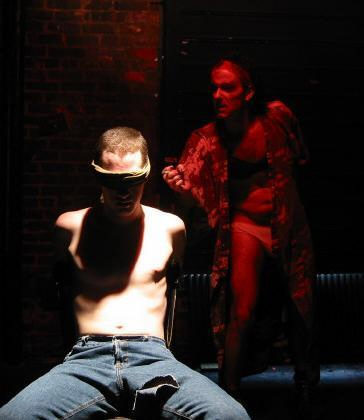
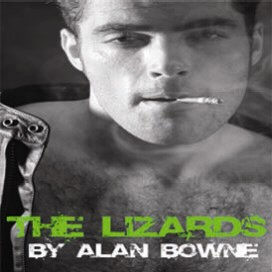
The Lizards **½
Half Life **½
Weight **½
Unspeakable: Richard Pryor Live & Uncensored, a Dramatic Fantasia **½
Channel Rat **½
Pipe Dreams **½
The Last Two Minutes of The Complete Works of Henrik Ibsen **½
Sex with Jake Gyllenhaal and Other Fables of the Northeast Corridor **
ScrewBall **
Finger Love **
Cemetery of Lips ** (caught post-Fringe on 10/2/05)
Faker **
The Metaphysics of Breakfast *½
Not Dead Yet *½
Dance With Me, Harker (stayed for first 45 minutes only)
Travis Tanner (stayed for first 15 minutes only)
Reviews of 56 of these productions, and anecdotal write-ups of the two shows only partially watched, appear below.
Note:
If I didn't catch a show, that doesn't mean it wasn't worth seeing; I
had time to attend only about a third of the 180+ productions at this
year's Fringe. If a show enjoys another run and I see it post-festival,
I'll add it to the list (with an annotation) and review it then.
I've assigned all reviewed shows one to four stars, using the following rating system:
**** = Transcendently Great
*** = Solid & Worth Seeing
** = Unless Your Relatives Are in the Cast, Think Twice
* = "I Wanted to Kill Myself"
Please keep in mind that these reviews were written in a hurry. If you spot any factual errors, please don't hesitate to let me know by emailing hy@hyreviews.com. I'm always happy to make corrections and updates.
Rating: ***½
One of the most compelling stories ever told is that of Faust and his deal with the Devil.
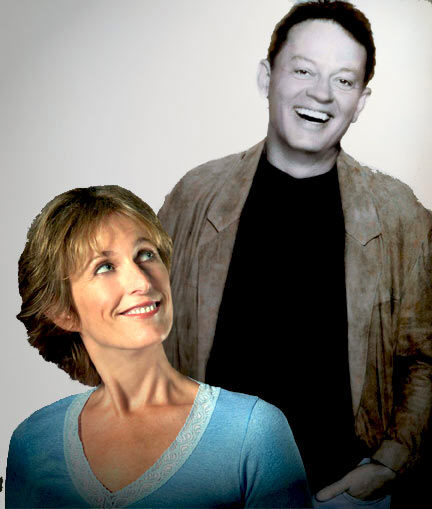
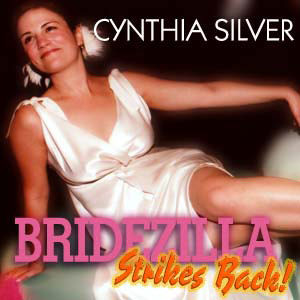
Bridezilla Strikes Back! has the same appeal. Only in this true story, Faust is a struggling theatre actress, and the Devil is reality TV.
The saga begins when Cynthia Silver's wedding planner informs her that some UK documentarians want to film every significant moment of select New York brides preparing for their nuptials. For the talented but relatively unknown Silver, it could be great exposure, capturing her personality for an international audience. She's told the documentary could even be picked up by the BBC. But it would mean allowing strangers to invade her life, and ceding any creative control over the process or the finished product.
The difficulty of the choice is exacerbated by there effectively being two Cynthia Silvers. One is a serious, dedicated actress who has devoted years to performing in small-budget theatre productions and honing her craft.
But the other is an aspiring starlet who craves attention, glamor, wealth, and, most especially, fame.
The struggle between these two aspects of her nature is evident when Silver talks about her fiance. An attractive and fashionable woman, Silver admits that the man who proposed to her wasn't really her type. She normally dated guys who were smooth-talking, high-powered, and dangerous.
In other words, assholes.
But the part of Silver that's wise and sensible gave this man a chance; and when he proposed, she said yes.
When the documentary offer appears, though, the other side of Silver can't resist. And who can blame her? It's an opportunity to marry a real man and yet continue to be courted by assholes.
Silver's fiance grudgingly plays along, although he consistently comments, "I don't trust those bastards."
And, of course, he's right. The sweet documentary about brides in New York is sold to FOX; and it's turned into Bridezilla, a reality series about the monstrous egos of women trying to create their perfect day.
As the title implies, Bridezilla Strikes Back! is, on its most basic level, born from a desire for revenge. But this one-woman show is much more than a screed. Silver takes us step by step through her whole journey, including the temptations to which she willingly succumbed, and the rapacious nature of those who feed a medium always hungry for fresh melodrama.
The script, by Silver and collaborator Kenny Finkle, is exceptionally well-written: thoughtful, witty, and rich with entertaining anecdotes. (The details of Silver's wedding travails made the women in my audience gasp with empathy...) And its underlying tale of vanity and temptation couldn't be more universal.
But what makes the show extra special is its star. On the one hand, Silver is an accomplished actress, so she can deliver a very polished performance. At the same time, though, she was genuinely hurt by her experience; and there are times, especially during the initial 15 minutes, when you can sense that she's still wary of exposing herself to strangers. The struggle between the slick performer and the real woman isn't a planned part of the show; but it's riveting.
Silver may have a tough time maintaining that balance as she grows more comfortable telling her story to audience after audience; but if she can somehow remain vulnerable and honest for each performance, this is a production that richly deserves a commercial run.
Meanwhile, the show has garnered a huge amount of attention and press (including a rave from The New York Times). So Silver has already achieved the fame she was seeking—and on her own terms, by practicing her craft.

2.
The Miss
Education of Jenna Bush
Rating: ***½
No star shined as brightly at this year's Fringe as Melissa Rauch. Charisma, artistry, wit, timing, intelligence, compassion, looks—Rauch has it all. She's already a regular on VH1's Best Week Ever; but based on her performance in the festival, Rauch has a much more impressive career ahead of her.
And, oh yes, her one-woman show is fun too.
Set in a messy living room with a "Good luck, Jenna" banner across the wall, the production focuses on the day before President George W. Bush's reportedly hard-partying daughter takes on the job of a Washington, D.C. grade school teacher. Perpetually hyper, Jenna wears a white sweats top (as if she's ready to race out for a jog at any moment) and red underwear with the words "Tex Ass" across it. The surface joke is that neither Jenna nor her dad seem very smart or responsible, and that they both still have a lot to learn before taking on a job that involves leading others.
In lesser hands, this could have easily become a flat, dull rant against the Bush administration. But Rauch and cowriter Winston Beigel instead opt to treat their Jenna with great affection, making her a vibrant character who transcends mere politics and—unlike her polarizing dad—ultimately speaks for everyone in her generation.
Maintaining a delightful Texas twang, Rauch paints Jenna as a mischievous, ebullient gal who can get into trouble and occasionally feel down...but never for very long. As Jenna explains, "You're mad when you're angry. I'm pissed off, like, 90% of the time. But not mad."
Here are some other snatches of her 90-minute routine:
Complaining to a takeout place about a soda delivery: Yes, I ordered a Diet Coke. But this is caffeine free. I ain't Mormon.
Admitting that people at parties don't take her seriously because of too many false alarms: They call me "The girl who cried puke."
Upset about those who put her father down: I don't want Daddy in the White House, either. But it's different when somebody else says it.
Contemplating Vice President Cheney: If you're named Richard, why would you call yourself Dick? Dick. It still makes Daddy laugh. It would be like calling myself Vagina. Vagina Bush!! (falls to her coach, waving her arms and legs in hilarity)
On gay rights: Now, I love Clay Aiken...
On her intellect: I know I'm no Leonardo Picasso...
Yelling at someone on the phone, and simultaneously making us adore her: I hate you. I hate you. Okay, I love you. Bah.
Rauch is a whirlwind as she paints Jenna with one layer of detail after another, ranging from demonstrating cheerleader moves to singing "Ah'm lahk a birrrd...." to inadvertently inventing new words such as "metaphorism."
That said, there isn't much of a narrative, so those who demand a traditional structure may find the piling on of details wearing. Rauch trained at New York's famed Upright Citizens Brigade, and UCB's improv comic sensibility is very much in evidence as Rauch looks for the truth in moments and scattered short scenes rather than a conventional step-ladder story. In that sense, the show is virtually an art piece. The fact that it succeeds so well in entertaining large and diverse crowds—Miss Education ended up winning the Fringe's Audience Favorite award, as well as an award for Outstanding Solo Show—is a testament to the energy and skill of Rauch's performance. It's also quite exciting, because Rauch is demonstrating an alternative approach for the New York stage that could end up attracting MTV-generation audiences who normally don't go to the theatre.
But the true greatness of Rauch is that she's more than merely cool. For example, on the opening page of her Web site, she includes this celebrity testimonial:
"Melissa Rauch is a very special young lady."
—Melissa's Mother
As long as Rauch continues to stay in touch with this down-to-earth quality, while at the same time maintaining her top-level comedic acting skills, there's no limit to how far she can go.
If you have an opportunity to see Rauch on stage before she's grabbed up by Hollywood, don't miss it.
Rating: ***½
They say lightning never strikes twice in the same place.
When it comes to family, though, lightning hits the mark again and again—by way of patterns of destructive behavior passed along to each new generation. Such dysfunctional cycles wreak as much havoc as any force of nature.
That's evident in this thoughtful, fierce play written by David Ozanich. The drama is set at a (real life) art installation by sculptor Walter De Maria consisting of 400 metal poles, set at intervals spanning a mile across the New Mexico desert, that are designed to attract lightning. When they do, the sight is supposed to be spectacular.
On the trip are two gay lovers, Sam (H Ryan Clark) and Andy (Cory Grant), who are contemplating making their long-term relationship official. Along with them is Sam's divorced father Gerrit (Ron McClary) and Andy's divorced mother Lori (Bekka Lindström). As we get to know them, it becomes clear that Sam and dad Gerrit have much in common, as do Andy and mom Lori—even to the point of Gerrit and Lori becoming increasingly interested in each other. But each character is a human lightning pole, both attracting and being attracted to some of the darker elements that reside within all of us. As these aspects of their nature are slowly revealed, we see flashes of dependence, infidelity, physical violence, and emotional violence. And when the lightning strikes, it is indeed spectacular.
Enormously enhancing the play is superb direction by Jared Coseglia. The cast is also fine; particularly McClary, whose acting serves to anchor the story in reality, and Grant, whose expressive face and body language guide us through the emotional upheavals (not to mention, he can do an impressive cartwheel...).
The play starts out quite slowly, and the first 20 minutes could arguably be punched up with humor to make the exposition more entertaining. The foundations laid by those initial scenes definitely pay off, though, ultimately providing unforgettable shocks and jolts.
It's also worth noting that while two of the characters are gay, this isn't a production tailored for any particular type of audience. All you have to be to appreciate the themes of this drama is human.
In fact, after you see the play, a rather dark game is to imagine in what ways the story would and wouldn't change if Sam were straight and Andy a woman...
And another game to try—especially edgy if you're with a date—is to discuss whether the ending is a tragic one or a hopeful one. The answer might end up being the equivalent of a Rorschach test on how you and your companion view relationships.
The Lightning Field deserves a life beyond the Fringe. The show enjoyed a successful extension at The Flea during September 2005. Here's hoping it now gets picked up for a longer-term commercial run.
Rating: ***½
The short, surface description: This is a play about men with small penises.
The longer, and possibly more satisfying, description: This is a play about the ways body image can twist our lives. While "small penises" makes for a great high-concept hook, the dynamics this comedic drama address are just as pertinent to, say, flat-chested women, prematurely balding men, the perpetually overweight, or anyone else whose physical appearance deviates from the norm in a way that's likely to make them self-conscious around the opposite sex.
The marvelous script by Martin Casella centers around a support group for men who are lacking "down there." Just how serious is their problem? The group members variously describe their attributes as:
Bottle
cap.
Baby
corn.
Stick
dick.
Little
Willikin.
A
pop gun, not a pistol.
A
bush, with a stubby little head poking out like a troll doll.
A grower, not a shower. (And then, as it turns out, not even a grower...)
The different ways this shortcoming has altered the life of each man is fascinating. And they may well lead you to think about the subtle, and not so subtle, ways in which your own behavior has been formed by perceived physical imperfections.
This is one of the (pardon the pun) meatiest shows in the festival. The story is about something both down-to-earth and important; Casella's script is uniformly wise, genuine, and entertaining; the direction by Matt Lenz is on-target; and the actors—Brian Leahy (Rick), Eddie Korbich (Joseph), Howard Kaye (Stephen), William McCauley (Father Kevin), and Roderick Hill (Keiran)—are all excellent.
In my opinion, this wonderful play could move to off-off-Broadway tomorrow, as is. And, if it was marketed right, it could do very well.
Rating: ***½
The first 20 minutes of this show are as funny as anything playing in New York.
We first see performers with woolly bits affixed to various parts of their bodies prance about, and then start dramatically singing, "This is the silence of the lambs!!!" Some sample lyrics (by Jon & Al Kaplan):
She must confront two evil men.
Which one is worse it's up to you.
One likes to cook and eat his patients.
One wears his victims like a suit.
This is the silence of the lambs.
You may have nightmares when it's through.
And if it leaves you feeling hollow
It scared the shit right out of you.
While this goes on, a jogging Clarice Starling—played to hilarious near-perfection by Jenn Harris—gives us the perpetual wooden expression, stiff tosses of the head, and odd lisp that Jodie Foster made so famous in the original film.
The scenes just get more silly and side-splitting from there, culminating in Clarice's delicious first encounter with Hannibal Lecter (played by Paul Kandel). Lecter is so moved that he privately bursts into song with the instant classic "If I Could Smell Her C*nt." Some sample lyrics (again, by Jon & Al Kaplan):
If I could smell her c*nt
She'd help me taste humanity again.
And if I promise not to eat her
Then perhaps she'd even be my friend.
If I could do it all again
I wouldn't harm a fly.
Erase the gruesome things I've done
And smell her cherry pie.
If I could undo who I am
I'd snap my fingers: brand new man!
I want to smell her bearded clam.
I almost can!
As Lecter croons, two expert ballet dancers suddenly appear; and they perform
maneuvers that place the woman's thighs by the man's nose during appropriate
lyrical moments.
Friends, musical comedy just doesn't get any better than this.
As you might imagine, it's difficult to sustain this level of insanity. And, unfortunately, as soon as Clarice leaves Lecter, both the humor and energy level of the play take a huge dip.
There are still numerous fun moments throughout the remaining 70 minutes; but it becomes an awful long stretch for what's effectively a one-joke show.
The key problem is that the parody is faithful to a fault. What the writers need to do is go beyond the surface details, hook into the spirit of Silence, and then use that as a springboard for a comedic tale with an organic life of its own. In other words, the show should be thoroughly enjoyable even to those who have never seen the original movie; and have so much aesthetic weight that, in time, others might be tempted to parody it.
Given that the bulk of the show often drags, and at times feels like it has no heart beyond surface parody, you might wonder why I'm ranking it so highly. The reasons are that this production demonstrates more professional attention to comedic detail than any other in the festival (with the possible exception of The Miss Education of Jenna Bush); and its first 20 minutes are worth more than five typical Fringe musicals put together.
If the producers are wise enough to rework this into something that transcends mere parody—for example, the way the classic film Airplane! does much more than just mimic disaster movies—Silence!: The Musical could become an off-Broadway smash.
Rating: ***½
The producers of Fleet Week: The Musical describe their show as follows:
Four blissfully unenlightened sailors and their queeny Chaplain hit the New York City streets for Fleet Week looking for romance and adventure. They stumble into a bathhouse (don't ask) where they overhear a dastardly plot (don't tell), but how can they stop it when nobody believes their story? (don't know) Come see the Statue of Liberty find love, the Coast Guard finally get some respect, and gay marriage save New York from a Martiniquean terrorist attack.
Unfortunately, that's almost all there is to the paper-thin book. If you're looking for clever plotting, strong story structure, or resonant themes, this ain't the show for you.
What makes Fleet Week special is its cast. Typically, a production has to settle for terrific singers who can sort-of act or fine actors who can more-or-less sing. This musical is blessed with numerous performers who manage both tasks with skill and style.
Topping the list of talents is Micah Bucey, who at last year's Fringe won a Best Performance award for portraying a madman crooning love songs in a straightjacket. This year, playing hero "Seaman Stayne," he's even better.
Bucey has a powerful, expressive singing voice that's a pleasure to hear. But beyond those pipes, Bucey is a formidable comedic actor, with a great feel for wording and timing, and never-ending energy. For example, during periods when all the other actors are just standing around waiting for a song to end, Bucey is doing subtle things with his pliable face and body language to keep you laughing. In addition, he has a natural charisma and edginess that effortlessly draws your attention to him whenever he's on stage. Bucey's abilities would transfer readily to TV or film; and there's no male performer at this year's festival who more deserves to be a breakout star.
Also superb is Bruce Sabbath, who plays the ship's captain and, most notably, a villainous redneck named Tex who says things like "I really, really hate them fags" in such an outrageously over-the-top way that you can't help but smile. (Happily, Tex's soul is saved when, with his last breath and for no discernable reason, he abruptly declares, "I regret my intolerant ways" before keeling over...)
Other fine performers include Rob Maitner as the sarcastic gay Chaplain, the one character you suspect realizes he's living in a musical; Laura Perloe as Seaman Swallows, a woman so determined to sail the world that she pretends to be a man (causing Seaman Stayne much sexual identity confusion when he falls in love with her); and Broadway veteran & Tony nominee Melissa Hart, who isn't given much to do as the Statue of Liberty, but belts out a number towards the end that's a showstopper.
Which brings us to the other notable element of the production: the songs. There are 20 of them (utilizing a variety of musical styles) crammed into the 2-hour show, and many are quite good. Sean Williams (music) and Jordana Williams (lyrics) did a fine job on that aspect of the production.
If the producers now hire someone with a strong understanding of story to craft an entirely new book; ruthlessly cut any songs that no longer fit; and commission new songs that integrate smoothly with the reworked tale, then this show might have a chance at a commercial life.
Even as is, though, the cast and music make Fleet Week a whole lot of fun, and a highlight of the festival.

Rating: ***½
Anna Marie Agniel begins this one-woman show by instructing the audience, "SLOW DOWN. Slow. Down. Slow d-o-w-n." Agniel then has everyone hold hands with the people next to them, and requests audience members to "Feel your neighbor's pulse. Feel the blood flowing. Feel their life."
In other words, open up; pay close attention; and be ready to connect with someone else—even someone very different—on a basic human level.
With this prep work done, Agniel effectively disappears for the rest of the 50-minute show—by transforming herself into her 22-year-old sister Mary Kate, who is mentally retarded.
If you're typical, "retarded" immediately elicits a series of stereotypical images and assumptions. But slow down; because this show simply won't allow for cliches.
What Agniel does goes beyond mere mimicry; she virtually lets her sister inhabit her skin. This is accomplished via intense attention to detail—creating distinct rhythms of stilted speech, holding her head and limbs at particular angles for particular types of activities, and dozens of other nuances.
The monologues are distinct as well, ranging from Mary Kate introducing us to a menagerie of stuffed animals as "my babies;" to her stating with unflinching honesty to a grief counselor about a dead classmate, "he was a pain in the ass;" to her outlining such career aspirations as, "I want to be a doctor. For monkeys and for dolphins. Not for sharks."
But the main thing that makes this show so special is the enormous love Agniel conveys for Mary Kate. By simply letting us get to know her sister intimately as a specific human being—someone who's direct; deeply feeling; perpetually frustrated with her dog; and who balances her frequent confusion with a pure joy for being alive—Agniel forces us to see past labels and love Mary Kate too.
About midway through the performance, when Mary Kate is struggling with illness, she slowly approaches the front row, bends down, and—without saying a word—persuades an audience member to lay a healing hand on her head.
It's an especially tender moment; and one in which it feels like everyone in the room is mentally linking hands to lend strength to that caress.
Rating: ***½
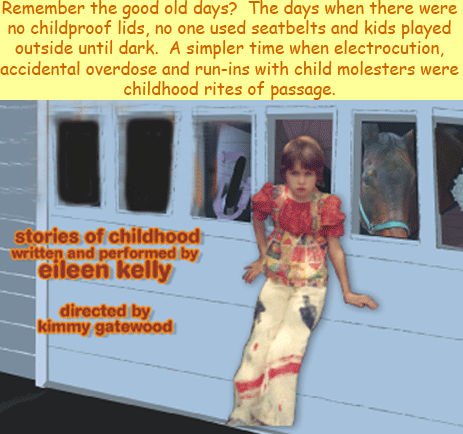
Wearing a T-shirt that proclaims, "New Jersey: Only the Strong Survive," Eileen Kelly actually has a lovely quiet strength about her. She projects both the inner peace and wry humor of someone who's lived through a great deal.
Many of those adventures are chronicled in this one-woman show, organized into mini-essays: a blackout, a title card, and then a story of childhood. And in the tradition of such giants as Jean Shepherd and Dave Sedaris, Kelly has some hilarious memories to share.
Apparently, when your parents have six children, any one kid is pretty much expendable. This laissez faire attitude was demonstrated by the time Kelly's dad first gave her a tablet of St. Joseph's Aspirin. She decided it was "delicious," so later found the bottle and consumed the rest of its contents. When Kelly began feeling poorly, she told her mom what she'd done. Her mother took a drag from a cigarette and replied, "Well, that wasn't very smart." End of anecdote!
Another time, Kelly decided to pry loose an extension cord...using a penny. She managed to knock out all the electricity in the house—and to propel herself into the next room. She also discovered the fascinating fact that you get the chills after being electrocuted. When she admitted what had happened, her mom wisely observed, "Who in God's name sticks a penny in an extension cord?" Kelly recalls, "You know what? I didn't do it again."
Kelly's family owned a candy store, but a Willy Wonka life wasn't as fabulous as you might think. Her parents used to give her massive supplies of Slush, "which was like a Slurpee, only sweeter." Says Kelly, "It was like mainlining sugar, but with a brain-freeze chaser. I'd take a hit of it and think, I want broccoli!"
In a home short of both money and time, says Kelly, 'things weren't fixed, just rigged. So you could use them at your own risk." This included the doorbell, which didn't generate a sound but would give visitors a mild shock. And when the door to the garage—which housed the kids' toys and bikes—got stuck, access to all those wonderful items was shut off for years. Kelly and her siblings used to go on for hours about what they could be doing with the stuff in the garage, eventually adding to its inventory things they've never owned...including a pony. When that garage door is opened, says Kelly, "me and my pony are going to ride like the wind;" at which point we hear the opening bars to the song "Wildfire."
Another problem was her mom's incessant chain-smoking. One day a concerned principal called Kelly into his office, pointed to the cigarette holes in her clothing, and gently inquired about child abuse. "Oh, all of my clothes have holes in them," Kelly cheerfully replied. "My mom smokes while she does the laundry." The principal was noticeably let down by the lack of a more dramatic explanation.
His instincts weren't entirely wrong, though; our young heroine soon developed a serious asthma condition, for which she had to be hospitalized several times. In those days, asthma patients were kept in a room under plastic bubbles that supplied them with untainted oxygen. Eileen still clearly remembers her mother coming in and demanding, "What's wrong with you people?! Why can't you do something to stop these attacks?!" At which point the doctor calmly looked up and said, "Mrs. Kelly, you can't smoke that in here."
The bad habit eventually caught up with her mom, who got cancer. During the final moments, her mother told Kelly she loved her. Kelly recalls, "She was like a maple tree in Autumn; a big beautiful burst of color before losing her leaves." Later, when no one else was looking, Kelly's dad sneaked a couple of packs of red Pal Mals into the coffin.
Kelly's childhood was both tough and funny; but "in the end," she says," there was a lot of love. That's what was left after the smoke cleared."
This is one of the best-written and best-performed shows in the festival. If you ever get a chance to see Eileen Kelly on stage, grab it; she's a thoroughly class act.
www.geocities.com/elementsofstylefringenyc
Rating: ***½
This enormously entertaining one-woman show by Wendy Weiner—who in real life is a freelance magazine copy editor—focuses on Winifred White, a stern woman who runs the copy editing department of a fictional women's magazine at Conde Nast. The production begins with Winifred speaking to audience members as if they were job applicants (and somewhat echoing Debbie Allen in Fame):
So, you want to copy edit.
You think you have what it takes to perfect punctuation, clarify language, correct errant thinking. I can tell you now that very few of you, perhaps none of you, have what it takes. A great copy editor can make incomprehensible drafts good, and can make the good writing great. It takes talent. It takes education. It takes constant vigilance. And today, today!, is where you'll start to pay—in sweat.
This is what's going to happen over the course of the next hour. In the next seven and a half minutes, I will explain the job to you, as well as what it's like to work at Conde Nast. In the following 12 minutes, I will look over your applications, at which point most of you will leave. And then, to those remaining, I will administer the copy test.
Pretty intimidating—and, thanks to Weiner's superb comedic timing and delivery, hilarious.
Why devote such passion to copy editing? Because, Winifred explains, when people become sloppy we get such horrors as the June 1996 cover of Ms. Magazine:
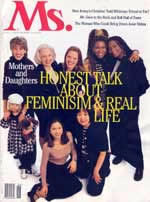
Take a gander at the large-type words in yellow. See a problem?
If not, look closer at the iconic word that Ms. Magazine is all about. It's not supposed to be spelled Feminisim.
Winifred sincerely hopes that you're appalled. But just in case, she clarifies why you should be:
I'll let you in on a
little secret: God doesn't create order in the universe. Look at our world!
Kosovo and tribal genocides, poverty and Paris Hilton, Survivor
and Adam Sandler—no,
He's not doing it. We are. We must.
When we don't follow
the rules, chaos reigns. We find ourselves confused. We find ourselves
miscommunicating
vital information. We find ourselves pregnant at 23 by the first man we
ever had sex with and subsequently raising a daughter alone in a culture
that does not support women raising children alone! (gathers herself together)
A semi-colon is not just a semi-colon. It is a symbol of the time our species first transformed oral language into the written word, the soul incarnated on paper, immortal, so that the thoughts and passions of one person could be saved, passed down, and understood by another person living thousands of years later. Although it may be the editors who get the fancy lunches at W and Balthazar, the free "swag" and lavish salaries, being a part of immortality, that—that!—is good enough for me.
Here we're in the trenches. Twelve million women a month read our publication; and for millions of them, this (holds up magazine) is all they read. Ever. Let me repeat that:: This is the only thing they read. And as their only example of the written word, it is vital that it be correct...I care about language, not just as it's preserved in an ivory tower, but as it's used in everyday life. And so I am here.
And we are right there with her. Winifred wins us over quickly, and garners huge and nonstop laughs. If the joyous wit of the opening 15 minutes were maintained throughout, this production would be unstoppable.
However, while Winifred appears in the bulk of the show, she isn't the only character. We also meet a fact checker, a senior features editor, an aspiring writer, a male freelance copy editor, and Winifred's daughter. And every time the focus shifts from Winifred, the energy level and laughs take a substantial dip. Although they're also given funny things to say, these characters simply aren't as well-developed and compelling.
For example, the senior features editor is depicted as an egomaniacal monster with no regard for others and a self-destructive obsession with her appearance. But, unlike the handling of Winifred, we're provided no positive aspects of the features editor's personality, or insider insights about the nuances and high level of skill required for her job.
The same goes for the other characters, who seem to be in the show to provide a rounded picture of what goes on at a magazine but—unlike Winifred—come off as stereotypes rather than real people.
That said, even these supporting characters provide some memorable moments. The best of them is the fact checker, who spends all day having phone conversations like this:
So, would it be accurate to say that one of the ways you keep your hubby happy is sucking on an Altoid before oral sex so that he gets a contact tingle from your mouth? Great. And that, once, you drove him crazy by placing a doughnut on his genitals and slowly eating it off? Oh, it was a bagel. Not a doughnut. OK. What kind of bagel? Everything. Great.
Winifred's daughter Celia is also intriguing. Engaging in slam poetry (an activity her mother abhors), she performs a piece titled "I Am Not Your Hyphen:"
Sometimes I am an
Em-dash, sleek and long
Beckoning
To another idea
The excitement of the unknown.
Sometimes I am an en-dash
Questioning my own relevance
Holding things together
That might be better left apart.
But I am not your hyphen.
The mistake you made
Long ago
Like the mistake
Of a secretary
Long ago
Ripping a hole in our family
No punctuation could replace.
I learned on my own
(And with the help of a highly trained professional)
That life is messy
So unlike the world of Strunk and White
Or the retouched
Pages of the magazine which
Paid for my therapy
And our small but lovely
West Side apartment.
That lays the foundation for some explosive mother-daughter dynamics. However, Celia and her relationship to her mom are never really explored beyond the poem.
Even as is, this show is well worth seeing, and a highlight of the festival. But if Weiner works at crafting all the characters we encounter with the same loving attention she gives to Winifred, and at maintaining a high level of energy and laughter from beginning to end—for example, bringing in other performers so that Winifred can remain on stage for the whole show—Elements of Style could develop into a post-Fringe smash.
Rating: ***
My review for this show was published in The New York Times on August 16th. To read the piece, please click here.
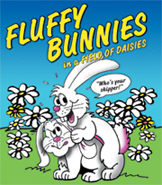
11. Fluffy Bunnies
in a Field of Daisies
Rating: ***
An infamous Fringe trick for luring audiences to a weak show is to give it a cute title. I was therefore quite leery of Fluffy Bunnies in a Field of Daisies. However, two very different friends—one with decades of professional theatre experience, the other a skilled stand-up comic—independently recommended it.
After caving in and seeing the production, I had to agree with my pals; the show is lots of fun. And I also understood why it was able to appeal to both of their diverse tastes: It's a high-energy sitcom that thoughtfully incorporates the traditions of the stage.
For example, the show kicks off with a first date that quickly leads to cunnilingus (strongly implied but never explicitly shown).
Following that is a lot of beer drinking and raucous conversation with buddies...and then more sexy situations.
In other words, it's a twenty-something version of Friends, only skirting close to (but not quite crossing) the line leading to an "R" rating.
As for the Fluffy Bunnies title, it's ultimately meaningless. However, combined with a cartoonish illustration of rabbits humping (see above), it lets potential audiences know the show is targeted at a college-age crowd; and also that no one should expect much of a narrative. In other words, a la Seinfeld, it's a show pretty much about nothing other than the mating habits and neuroses of single people who hang out.
For a series of character-driven vignettes, though, Fluffy Bunnies is surprisingly effective. This is largely due to Matt Chaffee's very witty writing and tight direction.
In addition, credit goes to the show's exceptionally strong group of young comedic actors—as far as I know, the best non-musical cast of the festival. (And, in fact, Fluffy Bunnies won a FringeNYC Award for Best Ensemble.)
Even within that excellent cast, though, two actresses stand out. One is Sangini Majmudar, whose character Yvonne regularly swings from scarily aggressive to tenderly vulnerable in a heartbeat. In lesser hands, Yvonne could easily come off as a psycho; but Majmudar is so brilliant in the role (and a terrific dancer, to boot) that we can't help but adore her.
The other actress deserving of special mention is Jenna Mattison, who as the perpetually smiling Jennifer must pull off the difficult task of fitting in easily as "one of the guys" while at the same time maintaining her sexy femininity. She manages this feat with the aplomb of a drummer who, without flash or special accolades, holds everything together for a really fine rock band.
With the right marketing—which Fluffy Bunnies' sharp producer, Drew Brody, is quite capable of generating—this show could definitely enjoy an off-off theatre life post-Fringe.
If this were my property, though, I'd shoot a few performances on HD, create a DVD with about six minutes of the most hilarious highlights—possibly followed by a 22-minute pilot version—and try to get it seen by executives at NBC, CBS, ABC, FOX, MTV, HBO, Showtime, and any other network that might opt for a sexy young sitcom. Last I heard, TV programmers were looking pretty hard for the next Friends. With a change of title, this breezy comedy's got a shot.
12. Feud: Fire in
the Mountain
www.newyorktheatreexperiment.org/feud.htm
Rating: ***
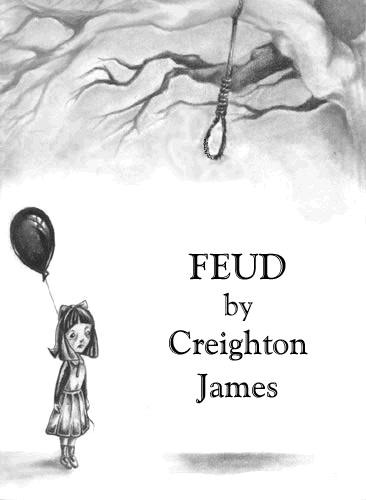
Following the end of the U.S. Civil War, a private war erupted in Appalachia between the Hatfields and the McCoys that became the most famous family grudge-match in American history. Writer/director Creighton James turns that iconic feud into a parable about the effects of violence.
The play first introduces us to the McCoys, whose family life is rendered so sweetly—complete with an adorable little girl (portrayed with grace by 6-year-old Jaclyn Tommer), two teenage girls (acted memorably by Angelique Gray and Laura Gale), three earnest sons, and a mom and dad out of The Waltons—that we could almost imagine heaven is like this. The father (Will Brunson) is a strong believer in turning the other cheek. He stands firm even when he learns that his brother, who fought for the Union, was lynched on his way back home by the Hatfields for taking the "wrong" side in the war...and, not incidentally, for owning some property desired by the head of the Hatfield clan.
As you might guess, family life at the Hatfields is a very different story. The dad (portrayed with gusto by Arthur Lazalde) is a sadist who regularly beats his boys and encourages them to commit random acts of violence.
The first half of this 2-hour play involves a series of provocations by the Hatfields, but the head of the McCoys refuses to take the bait. In Act 2, however, the McCoy sons reach their breaking point—and all hell breaks loose.
Everyone in the 18-member cast—among the largest in the festival—is fine. The three bluegrass musicians do an excellent job as well, led by Jon Rowan...who composed all-original music for this production.
The play's key problem is its muddled message. The tale ends with most of the characters dead, and the others grieving, effectively telling us that reacting with violence is always wrong. On the other hand, this same play clearly shows that there's evil in the world and people who'll mow down anyone who fails to stand up to them. Even for those who take a radical stance against all violence, there's a huge difference between the proactive protest of a Gandhi and the head-in-the-sand behavior of Father McCoy. At minimum, the show would've benefited from an additional 5-10 minutes following the carnage in which the surviving characters try to make sense of it all.
Nonetheless, Feud provides many memorable characters and some emotional scenes worthy of Greek drama. If you can get past the lack of a coherent point or proper ending, you'll find a great deal that's worthwhile here.

13. Confessions of a Dope Dealer
Rating: ***
My review for this show was published in The New York Times on August 16th. To read the piece, please click here.
Rating: ***
Michael Wrynn Doyle is an actor's actor. And no show in the festival better demonstrates a love for theatre than his.
Wearing a fake cast and holding a crutch, Doyle hops around the stage with the fierceness of a tiger as he spins a tale inspired by his experiences in Poland. Doyle went there to research the legacy of acting pioneer Jerzy Grotowski, who "created a completely different vocabulary of dramatic language," preaching that "our first obligation in art is to express ourselves through our own most personal motives."
Doyle's research hits a snag when he slips on the ice his first day in Lublin and breaks his ankle. This forces him to stay with a group of missionary nuns until he can get around again; and in return for their hospitality, they ask Doyle to teach them how to perform in a play. Doyle suggests Lysistratra, but the nuns aren't keen on a tale of Greeks and sex. He then puts forward Hamlet, but is asked for something from the gospels. They eventually settle on The Good Samaritan.
Of course, Doyle tries to apply his theories to the task: "I want to approach this piece primarily Grotowskian, and secondarily Stanislavski-Strasberg-quasi-Meisner with just a peppering of Le Coq."
He also tries to modernize the Samaritan tale: "Why don't we take a break and then we'll talk about my idea for Act Two: a dramatic discourse between Albert Camus and Jean Paul Sartre. It'll be like My Dinner With Andre, but their plates will be empty."
Doyle gives some memorable advice along the way, such as "The only way you can offend God is by indicating. Jesus loves a true moment."
The stakes are soon upped when Doyle's grant money is on the verge of being pulled unless he can demonstrate some progress in his research. Thinking fast, he tells the foundation "I am unable to meet with my contacts now because of my leg, however, I am working here at the hostel with a grassroots collective that is not represented in my thesis but is nonetheless a vital gem of contemporary Polish theatre. We are currently developing a major work based on a classical text. And this piece is intended to be seen by dispossessed audiences."
Actually, finding an audience proves to be a challenge, as the play is turned down by most—even the village orphans. Only one nursing home is willing to open its doors. Afterwards, Doyle analyzes the performance: "I don't think I can consider today a success. Yes, I take it personally; my directorial debut and a woman dies. Well, she was old; but still, theatre is not supposed to take lives. And we never got the audience back once they wheeled her out."
Doyle is despondent, believing his funding is sure to be cut off; and that he's accomplished nothing during his stay. And then he discovers a letter from the nuns to the foundation that turns his perspective upside-down: "Now we go to Kenya and show story of Samaritan. We show peoples our story of nice stranger so they trust us and take food and medicine and they hear us when we say take careful not to have AIDS. Our theatre save people lifes. You remember to hear what say Grotowski: There is no hero, no character alone. There is only community."
Considering this is Doyle's first one-man show, it's remarkably well-written; and, needless to say, his acting is superb. There's an energy and joy to his performance that stays with you for days afterwards.
Keep an eye out for Michael Wrynn Doyle. He's probably going to be a star.
www.hometown.aol.com/extravirginplay
Rating: ***
When a play starts out with two naked men having hot, sweaty sex, it's difficult to keep the energy level from rapidly descending once they're done.
Kudos to playwright Howard Walters for managing to do just that. In Extra Virgin, Walters employs taut dialogue, numerous twists, and a feeling of emotional danger to keep us in suspense and on the edge of our seats throughout.
At the same time, the drama includes generous portions of wit. Some sample lines:
Elias, after Noah asks which aspect of the evening he liked best: F*cking you. That was my favorite part.
Noah: You should write for Hallmark.
Elias: I stroked your cock. Do I have to stroke your ego as well?
Elias, on his dating preferences: I like skinny guys. They're usually well-endowed.
Noah: Well, the meat has to go somewhere.
Noah, on how he finally knew he was gay in college: I wanted to sleep with all the guys and be friends with all the girls.
Enhancing the play are superb performances from both actors: Kevin Creamer as Elias, the unsuspecting stud out for a one-night stand to get over a recent breakup; and Jimmy King as Noah, the schemer who knows a lot more than he initially lets on.
Director Michael Melamedoff also does a terrific job, crafting intense emotional and physical scenes to be credible and powerful, and making excellent use of the entire stage.
The play isn't perfect. After a while, the barrage of revelations feels somewhat strained; and the emotional build-up doesn't pay off to a really satisfying conclusion.
But until those final moments, Extra Virgin provides one hell of a ride.
Rating: ***
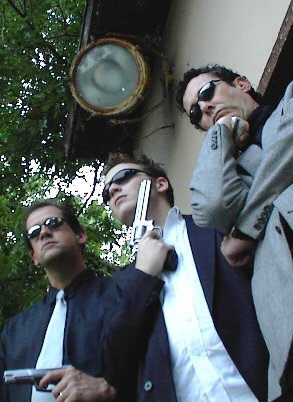
Virtually every year, amidst all the musicals, comedies, and one-person shows, the Fringe includes one taut crime drama; and it's typically among the highlights of the festival.
This year is no exception. For almost all the way through, Hit. hits the mark.
To include details about this tale of three hitmen would spoil surprises. However, I'll note that the writing, by costar Shanon Weaver (who plays young Asher), is smart and tight; the dialogue in several scenes is so much fun that it garners applause.
The acting—by Weaver, Ken Bradley, and Joel Citty—is also fine, with Citty a standout. But what's even more of a pleasure is how seamlessly the three actors interact with each other.
Director Melissa Livingston shines as well, creating a great deal of suspense with a very spare set.
The only significant problem is the conclusion. Part of the "reveal" can be seen a mile away; and the parts that are unexpected come off as illogical...and so unsatisfying. (The hardest element to get right for almost any story is the ending...)
Nonetheless, this is a terrific and memorable production.
17. Unholy Secrets
of the Theremin
www.performancekr.com/unholy.html
Rating: ***
The theremin may be the most bizarre musical device ever invented.
Unlike stringed or wind instruments, the theremin is never touched; instead, you stand before it and make motions with your hands. And the music that results often sounds like weird spectral voices from another dimension.
It's this latter effect that led the theremin to become widely used in Hollywood for a slew of science fiction films, such as The Day The Earth Stood Still and It Came From Outer Space; and for Hollywood psychological thrillers, such as Alfred Hitchcock's Spellbound and Billy Wilder's The Lost Weekend.
Invented back in 1919 by Russian scientist Lev Sergeyevich Termen, a theremin is basically a circuit board, housed within a box, that has a looped antenna sticking out of one side and an L-shaped antenna sticking out of the other. Each antenna emits a weak electromagnetic field that's disrupted by objects passing through it—such as a hand.
The loop antenna controls volume; moving your right hand near it makes the theremin's music go from soft to loud, and vice versa.
The L-shaped antenna controls pitch; when your left hand goes through its magnetic field, the variable frequency changes. The circuit board then detects the mathematic difference between the device's fixed frequency and the variable frequency, and calculates a third frequency; and when that's sent through an amplifier, you hear the theremin's unique sounds.
As you might imagine, it's almost as strange to watch a theremin played as it is to listen to it. To push this effect even further, the two "odd bird" performers of the show look something like this:
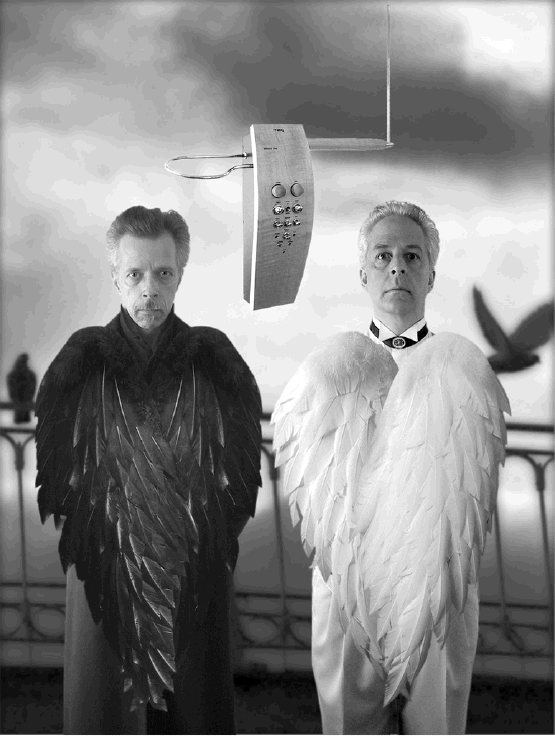
Kip Rosser (on the right) portrays an eccentric Russian—wearing a white fez with long yellow tassel—who plays the theremin like some mad priest of an otherworldly Ether. In real life, Rosser is a Pennsylvania-based playwright and director; and a highly talented actor.
Jef Anderson (the guy with the mustache) portrays an equally strange character, clad in a black outfit a ship's captain might have worn several centuries ago. Also a fine actor, Anderson provides expert keyboard accompaniment to Rosser's theremin playing.
But it's Rosser who commands the most attention. While jiggling his right hand back and forth to adjust volume, he continually makes conductor-like movements with his left hand, alternately slapping, stroking, and tapping the air in front of him and the L-shaped antenna. This activity coaxes tunes from his theremin ranging from classical music compositions to the Beatles' "Eleanor Rigby" to the theme for Star Trek.
In between this musical magic, the duo tell some outrageous yet apparently true tales of the device's inventor. These include Lev Termen entering the U.S. and changing his Russian name to Leon Theremin; trying to market his invention—during the Great Depression, no less—as the easiest musical instrument in the world (when it's actually among the most difficult to master); accumulating enormous debt when his business crashed and burned; and fleeing back to Russia...where he was promptly sent to Siberia and forced to invent sound-based devices that could be used to spy on U.S. embassies.
Rosser and Anderson also give us philosophy to match the theremin's unearthly sounds, such as theories about the perceiver and the perceived being inseparable ("if there is no one to see the room, the room does not exist").
The script could use some tightening and revising; there are periods when the 100-minute production drags. But Rosser's and Anderson's characters are consistently fun; and the show provides a rare opportunity to see a theremin being played with equal measures of skill and humor.
The
Tickly Cheeks Group
Rating: ***
Have you ever sat bored in your office, turned on some music, and just started dancing, slowly letting all of your inhibitions go—only to suddenly turn and realize someone's entered the room and seen you?
That true-life incident is the foundation of this wordless 30-minute show. Using cartoonish backdrops to indicate an office, two living rooms, and a subway car, we're shown the tale of a man and a woman who catch each "rocking out" to their favorite tunes. At first lonely and shy, they ultimately let each other enter their respective worlds—and end up dancing to the same beat.
The two leads, Gregory Jones (who's also the writer) and Tiffany Hodges (who's also the choreographer), are delightful as both energetic dancers, and actors who manage to convey pages of emotion with only facial expressions. Melissa Maxwell's thoughtful direction caps this utterly charming love story.
Rock Out is among the shortest and simplest shows of the festival; but it's a small gem.
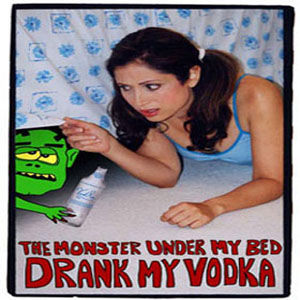
19. The Monster Under
My Bed Drank My Vodka
(to access two video clips from the show, click here)
Rating: ***
Lisa David Dean is a sharp writer who's adept at both acting and stand-up comedy. She makes fine use of these skills in her one-woman show consisting of autobiographical anecdotes, observational humor, and a variety of characters Dean brings to life with her distinct and versatile voice.
The main themes of Dean's story are addiction and compulsion. These began at an early age, when Dean discovered that her father's cough medicine gave her a warm, tingly feeling. No Robitussin girl, though, Dean insisted on the high-grade prescription variety...which, years later, she realized contained codeine.
When she was a bit older, Dean found that brandy had a similar effect. From that point on, she says, "brandy and cough syrup became my protective big brothers."
Dean also obtained comfort from routines and rituals, such as moving her head to the left and to the right before going to sleep, which she believed would ensure her family's safety—and keep at bay the monster under her bed. "It's a control thing," she explains.
A less benign habit was calling her grandmother every day at 3:30 (after getting home from school) in the guise of a kook named Bob, a pretense that gave Dean an adrenaline rush. When her clueless grandmother shared frustration about the harassing calls, young Dean suggested she change her phone number. Her grandmother did—ultimately, five times. But somehow, the omniscient "Bob" always got hold of the new number...
Dean soon developed more serious problems, such as food binging & purging. "Music is an important part of the throwing up ritual," says Dean. "To get in the mood, I'd put on Billy Joel's 'She's Always a Woman.' I'd wait for the part where he sings, 'Oh, she takes care of herself' and then let it rip."
But this was merely a phase on the way to Dean's true calling: alcohol binging. At one point, after downing a number of whiskey sours, a bartender suggested she eat something. "I don't want to waste my calories," she replied.
In the show, Dean periodically seeks advice from her delightful 8-year-old cousin Jeffrey, who serves as her guardian of common sense, with a lisp. "I was at a party and drank too many whiskey sours, and I kind of peed on myself," Dean confides to her cousin. "Wow," responds Jeffrey, "I haven't peed on myself since I was four." "Well," continues Dean, "I was throwing up at the toilet and had to pee at the same time. At least I was wearing underwear." Observes Jeffrey, "That's really bad."
It actually was really bad. Dean's alcoholism ended up causing blackouts and ruining friendships. Finally, after a near-fatal car accident, Dean's therapist convinced her to join AA.
What Dean hadn't expected is that when a bunch of people get together who have given up on their addiction of choice, "they're going to start screwing each other." This led to a series of unfortunate experiences with men—or, as Dean refers to it, 12-Step Dating.
Dean's first AA date was with a guy who took her to a diner, emptied Equal packets onto the table, cut the Equal into lines, and snorted them.
Another fellow "with a really small head" was rumored to fantasize about smothering women with a pillow. While sleeping together for the first time, Dean discovered the rumors were true, abruptly waking to find feathers in her face. To add insult to injury, shortly afterwards he broke up with her.
Looking back, Dean observes, "It's so much saner at the bars. When you take alcohol away from people, you see what they're really like. Crazy."
Dean says she eventually got off "the dating merry-go-round" by hooking up with a guy she ordinarily wouldn't have considered—in other words, who "wasn't an asshole." At the same time, she came to admit that she wasn't in control, but that her addictions were controlling her.
Dean is a brave and highly engaging storyteller who, despite her grueling life experiences, gets huge laughs throughout her hour-long act. The show's most significant problem is that it doesn't end so much as stop—because Dean's last-minute proclamations of finding a decent guy and seeing the light don't flow organically from everything else she's told us, and so come across as an artificial bow on the narrative rather than a genuine conclusion.
That's not entirely a bad thing, though. It indicates her journey through life's hard knocks is a continuing one, and over time we're likely to hear many more gritty tales from Dean—who shows promise of becoming a major comedic force.
www.ontological.com/current/stuckpigs
Rating: ***
Abalone (playing Gerture's ex-boyfriend Ian): Will you take it in the ass?
Gerture: But it hurts.
Abalone: You have to try your best to make me love you again. I work very hard. Sometimes I go to strip clubs after work just to get off. I get a lap dance. Don't worry, you're not allowed to touch in a lap dance. I don't touch. I just let them do their thing on my lap. I get a hard-on, sure. But you have to accept what being a man is. Men want to f*ck. Men need to f*ck. Men think about f*cking. Any woman you introduce me to, I will picture f*cking her. Even your mother, I will picture f*cking without any clothes. I may not even want to do it, but I will picture it.
Gerture: Poor men; what a big job, having to stick their dicks in the entire world.
Abalone: It is exhausting.
Both of the characters in this drama are emotionally exhausted. A brother and sister who grew up mostly apart from others—in a taped introduction at the start of the show, playwright Lally Katz informs us they were "shielded from the world by their protective parents"—the siblings developed the habit of acting out a series of ritualized roles. In the vignette above, they revisit Gerture's hurt at being dumped by her lover Ian for a different woman. In another scene, they pretend to be their own father and mother.
Abalone: Why did we have children, Mum?
Gerture: Because I was doing the dishes. Because you were working in a job. Because we had sex for something to do. Because that's what we do to be close. To look in each others eyes. For you to pull my hair before you're about to cum. Because I can remember that the next day and the day after, and it gives me a feeling of being close to you.
The parents are now deceased, although the cause isn't clear. We're given several different explanations: they "died tragically in a tree pruning accident" or "were killed in an ill-judged game of Russian roulette" or "had fatal allergic reactions to an orange-flavored birthday cake." Then again, maybe something more sinister happened.
The latter suspicion is fueled by Abalone's obsession with Macbeth. He practices the part continually in preparation for the eisteddfod, a local talent competition (which actually is a major fad right now in Australia, where the playwright and her troupe are based). The winner will receive a one-way ticket to Moscow.
At first resistant to this play within their play, Gerture eventually agrees to help out as Lady Macbeth. Abalone therefore commences teaching her about Shakespeare's classic:
Abalone: Question 3: What is the underlying theme in Macbeth? A. That love conquers all. B. That life is a competition fueled by one's desires. C. That ambition, when ill placed, is a traitor in one's spiritual fortress.
Gerture: I believe the answer is C.
Abalone: Incorrect. Life is a competition fueled by one's desires.
Indeed, although they love each other, the siblings subtly compete for dominance as their play goes on.
Gerture: I'm not gifted in any way. I'm a competent teacher, but I am not going to be as good as someone who has a real gift. So why bother? I can just appreciate other peoples gifts instead. Sure, sometimes I envy them. But not with a burning feeling. Just with a slight wistfulness. If you don't have it in you to be great, then you shouldn't try.
Abalone: You still should have gone for your personal best.
Gerture: This is my personal best.
Abalone: No it's not. You should get plastic surgery. You should take courses. You should try and aim for above average. Go to the gym. At least then, you would have pride. Pride is a very good way of masking mediocrity.
Portraying Lady Macbeth helps toughen Gerture, though; and after the eisteddfod takes place, we're delighted to see Gerture slowly turn to reveal a First Prize blue ribbon around her neck. She then finally lets go of past wounds and stifling relationships, leaving Abalone (a word that means "shell") for that one-way trip to Moscow.
Bringing this delicate production to life are strong direction by Chris Kohn, and tremendous performances by Luke Mullins (as Abalone) and especially Jessamy Dyer (as Gerture). Although the maze-like turns of the play can at times be confusing, Dyer's expressive face tells the story with such feeling that you can almost follow along by just watching her.
Still, when the lights come back on, we're left to wonder: Was there really an eisteddfod? Or was it yet another show within the brother's and sister's private world?
For that matter, did Abalone really exist, or was he just a figment of Gerture's imagination?
There are no definite answers in this challenging, layered play. But the characters' sadness, longing, and instincts for survival come across clearly.
Rating: ***
You know you're probably in for an entertaining evening when it begins with an announcement like this:
Ladies and gentlemen, prepare yourselves to be flung headlong into another dimension: a whirling miasma of perversion where no twisted carnal thirst in left unslaked. Prepare to enter a world where hip-grinding, hog-riding, pill-popping latter day sodomites will stop at nothing for the next thrill, the next kick. This world, ruled by a velvet glove that conceals an iron fist, is the world of Go-Go! (Music swells, then stops short.) ...and please turn off your cell phones.
That last instruction is important, because this show makes better use of sound effects than any other in the festival. In fact, Go-Go Kitty's Mark Huang ended up winning the FringeNYC Award for Outstanding Sound Design. Although our heroines are chicks on bikes (inspired by Russ Meyers' 1965 sexploitation classic Faster, Pussycat! Kill, Kill!), the actresses are given little more than black & white cardboard photos of motorcycles, guns, and other stock action devices. It's the sounds, and the sharp direction by Samuel Buggeln, that make these simple elements roar to life.
The whole story works on a similar ebullient cartoon level, as the Go-Go Kitties investigate the mysterious death of a transvestite...and, indirectly, fight to free our country of political hypocrisy and sexual inhibitions.
There are many fun moments in this adventure written by Erin Quinn Purcell, Greg Jackson, and Brian Hyland. Here's a smattering:
Police
Officer: All right, take it easy there, cupcake.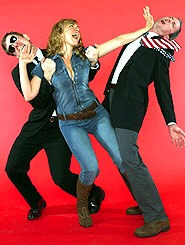
Go-Go Kitty Sugar: The name's not Cupcake! It's Sugar!
Gas station attendant Gramps: This pump here's broke, see.
Sugar: I hear they got a pill for that nowadays...Hey Gramps, where can a girl strap her mitts around a Ding Dong in this fillerup?
Evil villain Dick: You're all dirty girls with dirty pillows and dirty souls!
Sweet, innocent Peggy: You don't think I'm—a slut?
Hippie Billy: Oh my goodness, no. That's just some word the Man made up to make a girl feel bad about havin' a good time.
Go-Go Kitty Wanda: It's either Dick or your Daddy that's responsible!
Peggy: You don't know Dick. Or Daddy!
Wanda: Oh, we know Dick alright!
Political whistle-blower Sore Throat: I don't like newspapers. I don't like shallowness and sensationalism. I don't like the Family Circus.
Busty, an expert at handling men:
Ever since Eve charmed the apple from the snake
What they got is yours to take.
You don't gotta clean and you don't gotta bake,
You just grind.
They got a built-in leash for you to lead 'em.
They don't even care how mean you treat 'em.
No need to join 'em when you know you can beat 'em.
When you grind.
Billy: Sometimes losing yourself is the only way to find yourself. People like you and me, we've got a fire inside of us.
Peggy: I think I've been afraid of my fire.
Billy: Don't be. It's the burning fire of your soul made flesh. And that flesh wants to rock! I wanna rock with your fleshy soul-fire! I love your fleshy soul-fire! And you've got to love it, too! Cause it's a beautiful fire. It's a great, big, beautiful inferno. And when we put those two fires together, it's like...it's like a great...big...huge...inferno.
Peggy: Oh Billy, that's...so...
(They kiss passionately.)
Chorus:
Police the WTO—Go Kitty!
Uphold Wade V. Roe—Go Kitty!
By Angela Davis' 'fro—Go Kitty!
I'll fight the status quo—Go Kitty!
Go, Go, Go-Go Kitty,
In the rain or snow—Go Kitty!
Light or heavy flow—Go Kitty!
Go, Go, Go-Go Kitty now!
Despite the terrific energy of the above, this 90-minute show isn't a smooth ride throughout. It could use more wit and weight, fewer easy double entendres, and a much tighter story structure to avoid periods that drag. But with scenes ranging from motorcycle vs. car duels to Washington scandals to a wild acid trip (which is the highlight), there are a number of delights here. If you've ever wondered what Roger Corman might've done with Josie and the Pussycats, the Go-Go Kitties await you.

22. Uncle
Sam's Satiric Spectacular
www.actorstheatreapprentices.org
Rating: ***
My review for this show was published in The New York Times on August 22nd. To read the piece, please click here.
Rating: ***
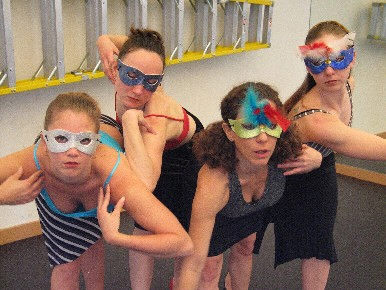
Regina Nejman is a choreographer and dancer known for mixing a variety of styles. In this show, six dancers (one male and five female, including Nejman herself) run the gamut, performing ballet, modern dance, yoga, Alexander technique, Capoeira, gymnastics...and some moves falling under the category of "sheer silliness."
And they do all this while periodically wearing red high-heeled shoes and unsettling glitter-masks (see photo above); or by dancing in buckets.
This frenetic activity is synchronized to Brazilian pop and electronic music scored by Mio Morales, Nejman's long-time collaborator.
This show doesn't aim for the heart the way, say, classic ballet does. But if you appreciate playful experimentation, you're likely to enjoy the energy and skill of Nejman and her company.
24. Little House on
the Parody
www.littlehouseontheparody.com
Rating: ***
In the 1870s, the Ingalls family settled into the small frontier town of Walnut Grove, Minnesota—and dealt with extreme poverty, hunger, disease, violence, and frequent death. What better foundation for a musical comedy?
Thus was born Little House on the Parody, which pokes fun at both the classic books by Laura Ingalls Wilder and the famous Little House on the Prairie TV series.
The musical's book, written by Becky Eldrige and Amy Petersen, is most successful when it explores the hardships the Ingalls endured—which included tornadoes, fires, and hordes of crop-eating grasshoppers.
Eldrige herself is also a standout as Laura Ingalls, bringing intelligence and heart to the role.
The lyrics and score, by Andy Eninger, are also fun. Here are some lines from "If I Was a Horse," which turns a potentially wholesome song into utter filth:
If I was a horse
And you was a mountain
I'd ride all over you.
If you was hay
And I was a pony
I'd never leave you alone.
Despite these positives, however, the show relies too much on parody, as opposed to creating a strong reality of its own. For example, while Eldrige is personally compelling, her writing doesn't make us care deeply enough about the other characters. And the show doesn't push at the inherent tragic elements of the story to the extremes that a comedic master such as Mel Brooks would.
But for those who are both already fans of the Ingalls and are able to laugh at them, this musical is worth catching.
www.eileenfogarty.com
Rating: **½
Eileen Fogarty doesn't
look like you might expect. Her Irish dad named her Eileen, which means
light; and his last name is Fogarty,
which means outcast.
But her full name is Eileen Diem Hoang
Fogarty. Her Vietnamese mother gave her the middle part, explaining "it
means nothing, but it sounds so pretty."
Eileen looks entirely Asian; but none of her four siblings do. And so the question becomes, is her dad really her biological father?
That's the true-life mystery that drives this one-woman show. It's a rather slender thread on which to base an entire production, given that the answer's either yes or no; and Fogarty's recounting of her experiences while trying to learn the truth veers perilously close to becoming an indulgent exercise in self-therapy.
What makes the show work are Fogarty's charm, wit, and verve as she play15 different characters, including her dad, her aunt, her siblings, and her friends—but most especially, her mom.
For example, Fogarty eventually decides to confront her mother about her parentage doubts. She knows her mom will bolt if given the chance; so Fogarty designs a two-hour car trip and then asks while driving on the freeway, thinking even Houdini couldn't escape such a trap. But her mom responds, "Stop the car! Stop the car! Mommy will walk home!" When Eileen keeps driving, her mother uses the trump card: "Okay, Mommy will kill herself! Mommy will kill herself in the car!"
In another confrontation scene, Fogarty's mother—still utterly refusing to answer the question—declares, "You don't know anything! You don't know my life! One day, they will make a book about it, and then a movie, and a famous actress will play me, and then you will know my life!"
Fogarty's hilarious portrayal of her mother, her keen observations of her own internal journey, and her consistently strong performance make this a very pleasant show.
Rating: **½
For anyone who's ever spent time in an Internet chat room, or tried online dating, this one-act play by Michael Puzzo has special appeal. It's about a recently divorced man named Mitch (played with great verve by Sidney Williams) who invites a chat room connection up to this cabin for a sexual rendezvous. Only the latter, named Lino (portrayed with effeminate charm by Kevin Cristaldi), neglects to mention something, as revealed in this edited exchange:
Mitch: You tricked me. I mean, I really thought you were a—
Lino: A woman.
Mitch: Hell, yeah, a woman. But not just any woman. You had me believing you were like, the woman. All that, "I have long strawberry blonde hair right down to my cute little ass" shit. Jesus, you're a f*cking sicko.
Lino: I just wanted to be what you wanted.
Mitch: "I work at Hooters to pay my way through nursing school."
Lino: I went to Hooters once.
Mitch: "My breasts are 38 Double D, round, firm, and very sensitive—and yes, they're real." Damn, that's some serious Penthouse Forum shit!
Lino: You said you liked big breasts.
Mitch: Of course I do. But on a woman!
Lino: You said nobody ever made you cum like that before.
Mitch: Ohhh, gross...
Lino: I lied, yes. But not about myself. I invented another person...I made something beautiful...You, on the other hand, lied about who you are.
Mitch: What?!
Lino: I mean, do you really have a 12-inch—
Mitch: I will not talk to you about this.
Lino: It was all, "How are you? Hey, have I told you about my cock?" and "So, what's your favorite color? Would you like to know the colors of my cock? Do you know my cock can speak Portuguese? Hey, my cock won the Kentucky Derby three times in a row. A lot of people don't know this, but my cock invented the cotton gin."
Mitch: Stop. Please. I don't go in for the dirty talk.
Despite Mitch's plea, this show ends up quite cleverly exploring "the dirty talk;" and of both the value of fantasy and the danger of pretending to be someone you're not.
Williams and Cristaldi have fine comedic chemistry that's somewhat reminiscent of Jackie Gleason and Art Carney (if The Honeymooners was written by Richard O'Brien...). The script is too slow and coy in getting to the point—the dialogue above doesn't occur until about midway through the hour-long play—but the last 30 minutes provide a series of thoughtful and unexpected pleasures.
Rating: **½
As demonstrated by such plays as Frankie and Johnny at the Clair de Lune, focusing on two lonely people trying to connect in a room in real-time can be quite poignant.
In this case, writer/director Kelly McAllister sets his story in a bar. The characters are Tom, who's divorced and not yet over the pain; Charity, who's seeking something real; and a female bartender named Janus, who periodically chimes in.
The play includes some witty and charming lines. For instance:
Tom, on his ex-wife: I was hoping for faith, hope, and charity. But I got the complaint department at Sears.
Charity, on her previous boyfriend's successful hookup line: "You. Me. Bed. Now." Romantic, isn't it?
Tom, on bartender Janus: She's seen me at my worst—drunk, sad, stupid. And that's just tonight.
Charity, on Tom: I don't care if you're a little wacky. Just don't be full of shit.
On the down side, though, the dialogue—especially from Tom—too often turns into pompous, self-indulgent monologues. Also, pretty much the same things are said over and over.
What actually gives this tale its heart is the thoughtful, feeling performance of Ashley Wren Collins as Charity. Collins' expressive face, intonation, and body language make us understand Charity's deep loneliness and longing to feel alive with more eloquence than any scripted words.
Jodi Dick, in the smaller but important role as Janus, is also excellent.
However, even at 75 minutes, the show feels way too long. And the downbeat ending is incredibly unsatisfying.
In my opinion, McAllister should chop out about 30 minutes, and make what remains of the script the first act of a 90-minute play. The second act could then serve to address all the issues Tom and Charity bring up but, instead of being resolved, are simply left to gasp final breaths in a corner of the barroom floor.
Even with its myriad of problems, though, the play in its current form is worth seeing for its intelligence and bittersweetness; and for the memorable performance of Collins.
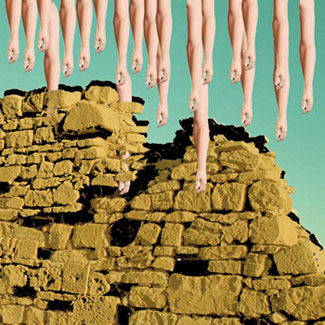
28.
Good Fences
Make Good Neighbors
Rating: **½
This show is a Fringe rarity—a serious play about a serious subject that's executed with conciseness and wit.
Good Fences is an allegorical tale set in the Middle East about a writer who may or may not have lost his arm to a bullet; his negotiations with an elf to maintain a wall between him and the neighbors who may or may not have shot him; and his increasingly tense relationship with his wife.
The wife is played by Donna Abraham, who is simply radiant in the role, and a standout. Abraham is a former sergeant in the Israeli army, so casting her must have been an easy choice. (I'm familiar with some of Abraham's other work, though, and she can portray, say, an Irishwoman with equal assurance...)
The supporting actors are also good, particularly Michael De Nola as the doctor. The male lead seemed miscast as the writer, however, coming across as more grating than engaging.
As for the story itself, tackling Middle East issues via fable is a smart approach. But even as a fairy tale, it could have been a little less coy; and the relationships between the characters a bit more three-dimensional.
That said, this is a solid production; and its young playwright, Adam Klasfeld, is a sharp talent worth keeping an eye on.
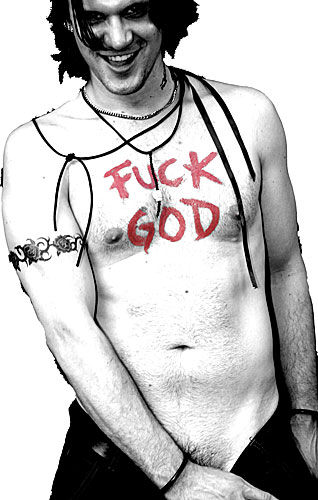
Rating: **½
Based loosely on The Beggar's Opera, this musical portrays a future stinking of corruption and moral decay.
It's therefore ironic that this show's biggest problem is neglecting to focus on its love story.
To be clear: The band rocks the house. The music part of the show is fine.
And there are also many talented singers and dancers in the cast—including an actress I know and like enormously, Sarah Engelke. But the show never develops their characters beyond empty cliches and so it's impossible to care about them.
The only relationship that's genuinely compelling is that between Mac the Knife and his girlfriend, Polly Peacock, who exchange such delightful lines & lyrics as:
Polly: Gangsters make my girl goop gush.
Mac: Death is how I love. Slaughter is how I care.
Polly: It makes me wet when you spit on me.
Mac: If you learn the signs of my affection, you won't question why I threw you down the stairs.
Polly: Your meat metaphors make my crock pot bubble.
Really, folks, what more does anyone need?
And yet, even here there's a problem—because the actress who plays Polly, April Vidal, is phenomenal in the role. And April's talent overshadows the guy who plays Mac. Quite simply, April steals the show.
If the producers opted to rework Banger's into a focused—albeit insane—love story, and if they found an actor/singer who could hold his own with April, they might have something.
Otherwise, if anyone reading this is looking to cast a sexy and/or funny musical, two words: April Vidal.
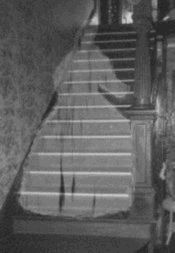
30. Dark
Deceptions: The Seance Experience
Rating: **½
Todd Robbins is a witty, charming, and sly performer who's been performing vaudeville-style acts for years via Coney Island and his previous production, "Carnival Knowledge." He's now premiering this new show, which recreates the trickery of 19th-century psychics.
"For the last 150 years," say Robbins, "the Spiritualist movement has attempted to make contact with the dead. For that first day to this, it has been a movement filled with both fraud and delusion. This show will be no different."
Robbins proceeds to trot out classic deceptions, ranging from objects being moved by spirits, to spirits affecting pulse rates, to projecting thoughts: "I'm thinking of a foreign capital. A foreign capital. All right, how many of you received Paris? Good. Actually, I faltered for a moment and thought of London, so some of you may have picked up on that instead. You did? Good..."
If the latter sounded a bit lame, well, that's the case for a number of the bits in the show. In addition, Robbins uses an awful lot of "filler" talk in between deceptions, making the show move quite slowly. I couldn't help thinking Penn & Teller would be cramming about three times as much magic into the same amount of time; and would also be updating most of the tricks to make them effective for a modern audience.
On the up side, Robbins is a natural showman, and watching him play con man as the shades-wearing Pastor of The Church of the Parted Veil is unquestionably fun. He's also putting forward a worthwhile message: "I absolutely believe that spiritualists speak to the dead. It's just that the dead don't talk back."
My guess is that the performance I saw—the world premiere—was effectively a first draft of a production that will be evolving as Robbins gauges audience reactions and makes improvements. If you opt to catch this, you might want to see one of the last two FringeNYC performances, on 8/20 or 8/24; the show might be a bit tighter by then.
Rating: **½
Will Franken is a sort of nerdish Robin Williams. In his 90-minute show, Franken's quick, hyperactive mind creates dozens of amusing characters in improbable situations.
For example, he acts out a California poetry slam which is visited by newcomer John Milton. The crowd ends up indifferent to Milton's excerpt from Paradise Lost; but they love an "urban street poet extraordinaire" named C.K. One who spouts such stuff as, "I am your worst nightmare...Do I look too fierce because I'm pierced? Are you worried? Are you in a hurry to scurry away from me as I drink my whiskey and my beer to drown out the fears of my years?...When your dad is beating you with a belt the size of a Mack truck, you don't give a f*ck. You don't stop to think 'should I drink?' You don't ask, that's not your task. You just take that flask and pour that whiskey down your throat, and that's your antidote—to the poison of the government, to the poison of the church, .to the poison of the schools—and their ruuuules."
When Franken hits the target, as in the above, he's hilarious. However, most of Franken's material is conceptual, which can create a somewhat cold, distant quality to his routines. In addition, a lot of his fun ideas peter out, as if his mind was racing too fast to stay with the scenario as a writer until he came up with a satisfying punchline.
Franken has a great deal of talent and potential, though. If he can learn how to slow down, and to write a bit more from his heart than his head, he could become a significant comedic force.
To hear Franken at his best, I recommend visiting his Web site and playing the MP3s he's uploaded of some of this funniest stuff. To access these routines, simply click here.
Rating: **½
If you visit Kathryn Graf's Web site about her one-woman show, you'll find a helpful FAQ. Rather than reinvent the wheel, here's the bulk of it (with slight editing):
Q: What's my show about?
A: A young woman suddenly widowed. It's my story. My husband dropped dead while dancing at my brother's wedding. (Many people may remember David as Eugene Tackleberry in the Police Academy movies.) Well, the show is a visit with him, but it is more about the aftermath of his death.
Q: What makes my show unique?
A: Its bare bones honesty. When I wrote it I wouldn't allow myself to flinch from the truth because of embarrassment or shame. I had a lot of issues, not the least was an overwhelming sexual need I couldn't come to terms with. I was surprised at how grief felt, and how inappropriate all my emotions seemed to be. I couldn't understand why I want acting like the stoical widows depicted in so many genres of art. Why I couldn't just "miss" him. I figured, if this is how I felt, then this must be how a lot of people feel. And I was determined to expose that truth, warts and all.
That's pretty much accurate.
I'll just add that reactions to this show may vary wildly, depending on personal perspective and experience. For example, I found Graf too cold regarding her husband—about whom she says shockingly little—and about her children, relatives, and friends. Even though Graf's premise is that she needed to let go and focus on herself following the devastating loss, I couldn't help feeling she swung a bit too far in that direction.
For example, Graf says it was tough "to not wrap my head around everything I've lost. But the hardest part was to make peace with everything I've gained." What didn't come through as clearly, though, was an acceptance that David could still be a vital part of her identity, even as she moved forward.
But while the show didn't quite resonate for me, after it was over I turned to see a woman behind me utterly in tears.
There are no easy answers regarding grief and loss. Ultimately, Graf deserves kudos for being brave enough to perform a show on this subject, and for allowing others to consider their own feelings alongside hers.
Rising Phoenix Repertory
Rating: **½
In a darkened room, Larry (Chris Kipiniak) reassures Chris (Denis Butkas), who is blindfolded and tied to a chair, that his being offered as a sexual birthday gift will go down as easily as a piece of cake. To prove it, Larry asks him to describe his favorite cake. After some reluctance, Chris responds:
Well, it's thick. And brown tasting. With that coconut ribbon. Sweet. Also thick, that ribbon layer. That was my favorite. I used to eat the cake just for that. I mean, I don't much like chocolate really. But that ribbon layer—it was sweet. And good. I thought—when I was younger—I thought that's what angels taste like. You know, if you kissed one. Like, real gentle. Like sweet ribbons of coconut. If you could kiss an angel.
Sylvie, the person for whom Larry hired Chris, soon emerges; and it's clear the only type of angel he might be is a fallen one. Then again, he could be an aging pre-op transsexual.
Playwright Mark Schultz's one-act is both dark and delicate, offering taut dialogue and, by way of Sylvie—acted wonderfully by Spencer Aste—a character as fragile as an eggshell who fears to break both his gift and himself.
After a while, the conversations grow repetitive and start to drag; and the story's resolution doesn't equal its suspenseful setup. But this show is nonetheless worth catching for its initial dialogue; its dark, bittersweet tone; and the memorable performance by Aste.
Rating: **½
There are certain shows you'd expect to see only at a Fringe festival. This quirky two-person comedic opera written by Joe Latessa is definitely one of them.
The story involves a mother (Kristen Freilich) who focuses on food preparation, and her plump daughter Lucy (Shannon Strodel) who becomes increasingly distracted from dinner by a lesbian she finds in the pantry.
That's basically the whole story. It works because Freilich and Strodel are terrific, both as singers and comedic actresses; and Latessa's songs neatly walk the line between melodrama and sheer silliness. Some sample lyrics, after the lesbian has passed away:
Lucy, heartbroken: I will never say a prayer again.
Mom, turned around: Prayers are just pretend
But lesbians are for real.
You see them and you touch them
And you know how they feel.
The mom then fixes a meal to commemorate the lesbian: Two large dishes of ramen noodles, which mom and daughter simultaneously bring to their lips in a heap resembling...well, use your imagination.
What does the lesbian in the pantry represent? Some have suggested masturbation. Or sex. Or individuality.
Or, maybe, lesbianism.
Whatever your interpretation, this musical fable is oddly entertaining, and worth catching.
Rating: **½
This multimedia production is a homage to both Hollywood movies and the people who love them. Conceived by Andy Donald (who also directed) and Dylan Dawson (who wrote the script and stars as the Movie Geek), the show is brimming with nerdy enthusiasm.
Movie Geek references dozens of classic films, including Citizen Kane (which is the primary source for its structure) and Zelig/Forest Gump (from which it borrows the technique of placing its hero into historical photos and newsreels). There are also scenes encompassing numerous film genres, including romance, comedy, film noir, the western, the war story, the musical, psychological thriller, science fiction, and the undead. And, rather impressively, there are filmed interviews about the fictional Movie Geek with such genuine icons as Kathleen Turner, Bill Cosby, and Henry Winkler.
The show additionally features entertaining performances from some promising young talent, including Dawson himself, and actresses Shannon Walker and Maggie Marion; and costume design covering a wide range of periods and styles from Laura Shiffrin.
What Movie Geek doesn't have, however, is much heart and soul. Unlike the films that it champions, the show itself doesn't manage to create characters we can care about, or a story that truly grabs and transports us. Instead, it mostly provides a barrage of cinematic references, and an energy that's fun for a while but starts getting wearing after about 30 minutes—which is a significant problem for a production that runs 100 minutes. Even the filmed interviews with the stars aren't nearly as good as they ought to be, because Cosby, Turner, and Winkler—all extremely sharp people—are given little of interest to say.
Along similar lines, one of the great failures of the show is its implication that loving movies is virtually the equivalent of making them. The truth is that some of the greatest film geeks alive are such industry giants as Steven Spielberg, Martin Scorsese, and Quentin Tarantino, who absorb movies as readily as they breathe air. However, they also take the extra leap of using their profound knowledge of classic films to create transcendent new work.
Perhaps one day Dawson and Donald will do the same. But they haven't yet made that leap with this show.
Rating: **½
Playwright Alan Bowne, who passed away in 1989, was known for creating punkish urban dramas laced with humor. The Lizards was his last, and remained unproduced until premiering at FringeNYC 2005.
Like his other work, this play features colorful street characters who are more violent than smart. All four members of the cast—Greg Mehrten (Maurice), Susan Gardner (Gooey), Sean Twomey (3-Yard), and David Gueriera (Kip)—offer memorable performances, and also have fine chemistry with each other.
Mehrten is a standout as the effeminate old queen who painstakingly clips and organizes pile upon pile of newspaper and magazine articles, and refers to all the newsprint in his apartment as History. When the two thugs played by Twomey and Gueriera unwisely hide 25 grams of stolen heroin in the apartment, and then discover the drugs missing a week later, they end up tearing History apart, turning the apartment into mountains of shredded paper. The chaotic energy of both this savage act and its visual aftermath are the highlight of the production.
Other delights offered by the play are the unique jargon and rhythms of the street dialogue; the violence that periodically erupts, which is well-staged by director Damon W. Arrington and fight choreographer Michael G. Chin; and a variety of small moments, such as Gardner cooly spitting a wad of gum across the room (which, deservedly, garnered the biggest laugh of the show).
Where the play fails is in such formal elements as plotting, pacing, and structure; because after History is destroyed (about mid-way through), not much else happens for the rest of the 90-minute show. And the ending is a huge let-down.
It's tempting to guess this is because Bowne died before fully completing the script; but Bowne seemed to often be uncomfortable with imposing classic structure on his stories. (It's the rare writer who combines the poetic anarchy of a Bowne with the jigsaw-puzzle discipline of, say, a Larry David.)
Also, in the wake of such adrenaline-pumping TV series as HBO's Oz and drug movies such as Trainspotting, many of the shocking elements of Bowne's 1980s play are now almost quaint.
Because of the solid work of director Arrington and the cast, the current production provides enough charms to be worth seeing during a Fringe festival. If there's interest in life beyond that, though, the producers might consider commissioning a script overhaul from a playwright who's both tuned to what Bowne is trying to accomplish and capable of creating a mind-blowing second act.
Rating: **½
This is the type of play for which they invented the term "problematic."
On the up side, the direction by Teresa K. Pond is elegant; and the cast is fine, with Anna Chlumsky (as the daughter) particularly memorable. Even the writing isn't bad on a line by line basis.
But what's terribly disappointing is the playwright's cliched approach to the complex and important subject of sexual child abuse.
In a country where Law & Order: Special Victims Unit airs weekly on NBC—not to mention, up to several times a day on the USA Network—there's no lack of information, or even fine drama, about pedophilia. However, because this play focuses on a predator who's just returned from prison and is trying to establish a normal life, it has the opportunity to provide nuanced insights into a pedophile's thoughts and behavior.
Instead, though, the felon (portrayed by Mark Lynch, who does the best he can with the part as written) remains a cypher throughout the production. Not only are we deprived of an understanding of what makes him tick, the character himself appears clueless.
Along the same lines, no solution—or even hope—is offered. The title, Half Life, refers to the thousands of years it takes for a radioactive substance to lose even half of its poisonous power, and that's clearly a metaphor for the high recidivism rate of sexual offenders. But by the end of this drama, the only courses of action for handling someone convicted of sexual abuse seem to be to lock him away forever or shoot him where he stands. That sort of cartoonish attitude sheds no light on this dark topic.
NAMBLA notwithstanding, there aren't many people who don't already know pedophiles are dangerous and recidivism rates high. Therefore, the play in its current form just seems pointless.
Which is a shame, because the story's foundation is a strong one; and given all the talent involved in this production, it could have been a great deal more than what it is.
www.magnettheater.com/weight.html
Rating: **½
For Melanie Hoopes to do any kind of one-woman show while seven months pregnant is impressive. For her to perform four one-acts about weight and physical image—and appear in a flesh-colored body suit as she switches costumes for each of the four characters she portrays—is pretty awesome.
Before the show begins, Hoopes puts us in the right mood with a selection of popular songs. These include:
Too Fat Polka: "I don't want her, you can have her, she's too fat for me..."
Duran
Duran: "Mouth is alive, with juices
like wine, and I'm hungry like the wolf..."
And, of course, the ever-enigmatic...
MacArthur Park: "All the sweet, green icing flowing down. Someone left the cake out in the rain. I don't think that I can take it, 'cause it took so long to bake it, and I'll never have that recipe again. Oh, no!"
Hoopes then plunges into
her stories. For each one-act, she introduces the central character by
first standing on a scale and announcing the woman's weight—hammering
home the degree to which this one number defines a person. The four women
are a TV couch potato so obese that she's housebound
(526 lbs.); a pop star with bulimia (135 lbs.); a woman attending her
high school reunion after losing 100 pounds (now 153 lbs.); and a female
caterer with an anorexic
daughter (140 and 120 lbs., respectively).
By far the most powerful
tale is the latter. The caterer doesn't even notice her daughter has an
eating disorder until a teacher calls her about it. At first reluctant
to accept the truth—"it
would be like a cobbler's daughter going without shoes"—she
starts noticing how her teen pushes the dinner plate away after only a
few bites. As the daugher's
weight of 120 starts to plummet, the mom snoops around her room and discovers
a troubling shrine with sayings gleaned from Internet diet sites:
Empty
is pure. Starving is the cure.
Nothing
tastes as good as thin feels.
Thin
is better than healthy.
This prompts a confrontation; but it does no good. The daughter just angrily declares, "You have a fat ass and you want me to have one too!" In the best line of the show, the mom observes, "This was hard to hear for a variety of reasons."
When the daughter hits 70 pounds, she has to be hospitalized. The mother responds with anger, eventually shouting to the doctor, "I'm the one who needs to be fed!" It's at that moment we realize the daughter may be externalizing a deeper kind of starvation.
Unfortunately, the other three acts aren't as illuminating, and (ironically, in this context) feel padded. If they were trimmed down, though, and the extra time filled by a number of other short but densely-written acts, this could become a quite special show.

Rating: **½
This tale of raucous ancient times centers around an emperor who marries an actress—a profession that, we're told repeatedly, was barely a notch above hooker back then. The population rebels, and much senseless violence ensues.
That's actually not a bad spine for a story. Unfortunately, this production doesn't structure it very well, moving the action at a snail's pace and shifting its attention in unsatisfying ways. There also isn't much dialogue—the nearly wall-to-wall songs made me think more of an opera than a musical.
That said, there's much to like about this show. The 16-member cast is uniformly solid, with standouts including Mark Light-Orr (as Emperor Justinian), Erica Ash (as a sexy singer/dancer), and Ian Pfister (adding some gravitas as the would-be usurper). In addition, the songs are all well-crafted and enjoyable; as are the costumes, the set, and most other aspects of the production.
In a nutshell, if you like lots of music and talented, great-looking performers, you'll probably enjoy this. But don't expect much of a story.
40. Unspeakable:
Richard Pryor Live & Uncensored,
a Dramatic Fantasia
www.unspeakablelive.com
Rating: **½
Midway through this play, an emcee makes this introduction: "Put your hands together for the two most beautiful words in comedy: Richard Pryor."
That's about right.
Richard Pryor is one of the greatest writer/performers of our time. He managed to translate his anger and pain into insights so layered, humane, and on-target that they struck a universal chord. Pryor's shrewd honesty made almost everyone laugh...and subtly changed attitudes around the country about race, sexuality, language, and life.
Ideally, a play that imagines key moments from Pryor's life in an attempt to show us how he became who he is would meet a similar high standard. That's not really the case here, though. Scenes of a young Pryor being sexually abused and deprived of his father's love, and of an older Pryor mistreating women and self-destructing on drugs, are more melodramatic and grueling than insightful and enlightening. Also, we're never made to really care about any of the characters in the play outside of Pryor.
Where the story does work, however, is when actor James Murray Jackson, Jr. gives us Pryor doing comedy. Even though Pryor's own material isn't used—the play is unauthorized, so incorporating Pryor's act would be a copyright violation—both the playwrights and Jackson manage to capture some of the spirt and energy of the real thing. That's no small accomplishment; and it's almost worth seeing this show for those moments alone.
Rating: **½
You can't help but like Tara Clancy. Coming on stage with a frilly white top, blue jeans, orange sneakers, and a punkish blonde 'do, about the last thing one expects is what comes out of her mouth—high-pitched, fast-talking storytelling with a major New York accent. Think Lori Petty in Tank Girl, only with a bleach job and a childhood in Queens.
With a non-stop twinkle in her eye and enough energy to power city blocks, Clancy is delightful as both a personality and a performer.
What Clancy has not yet accomplished, though, is putting together consistently compelling material. Her one-woman show is made up of a series of anecdotes about her childhood, her family, and her old neighborhood of Broad Channel, Queens (whose residents were referred to by some as channel rats, after the large number of rodents in the area). But the anecdotes seem arbitrarily tossed together rather than carefully selected and arranged; and they seldom elicit more than an affectionate chuckle.
Clancy, who bartends Friday nights at her uncle's Barrow's Pub (463 Hudson Street in Manhattan), could become a powerhouse performer. But she should probably team up with a hard-nosed editor and/or writer to create a much stronger script.
Meanwhile, you could still do a lot worse than watch this charming human dynamo spin her gentle yarns.
Rating: **½
Theatre rule of thumb: The best part of a show is usually the first half. Writers invest energy into laying out their ideas and characters, but then often run out of steam in Act II.
Pipe Dreams is a rare exception. In the first 50 minutes of this one-woman show, Nicole Blaine tries a bit too hard for artistic effect in portraying her relatively smooth early childhood (for example, too frequently repeating the ironic phrase "I was so grown up"); and we're left wondering what this is all about.
After the intermission, however, Blaine gets to the point: Her mother suddenly decides to dump her dad in favor of a man Blaine refers to as Scary Larry ("he looks like Christopher Lloyd on acid; a bug-eyed psycho"); and to become addicted to crack cocaine.
Crack does some nasty things. Mom imagines there are bugs under her skin—a common hallucination referred to on the street as coke fleas—and takes to picking away at her flesh with tweezers until there are sores all over her body. "This is not my mom," says Blaine. "This is a nightmare."
Meanwhile, Blaine continues, Scary Larry takes over their basement and devotes it to drugs and porn.
Blaine considers going to the police, but doesn't want her mom arrested. She's also hesitant to break up the family for the sake of her younger brother. And so, Blaine says, "I had no option but to watch my mom slowly kill herself."
As she keeps wondering, "Why does my mom like crack better than me?", one of Blaine's few sources of happiness is Friends on Thursday nights. Blaine fantasizes about one day becoming an actress like Jennifer Aniston.
Back at home, however, things get progressively worse. After a number of ugly incidents—including, says Blaine, Scary Larry periodically cheating on and beating her mother—Larry finally is arrested. The ending to this story isn't a simple one, though. After he's released from rehab, Blaine's mom opts to live with Larry again; and they're still together to this day.
Meanwhile, Blaine's dreams start to come true as she pursues a career as an actress. She often thinks of something he dad told her: "If you want the rainbow, you have to put up with the rain."
Blaine also eventually meets Jennifer Aniston, bumping into her at a Rite Aid. Blaine feels impelled to ask her idol whether she was ever worried about not succeeding. "No," Aniston replies, "I never was. Because I was happy being a waitress."
"But weren't you scared about not making it?" pursues Blaine. "Everybody fails," responds Aniston. "Success is learning from your failures."
Blaine would prefer happier memories. But she says her experiences ultimately made her "a strong woman—the strong woman my mother once was."

43. The Last Two Minutes
of The Complete Works of Henrik Ibsen
Rating: **½
What a disappointment.
Many people—including me—were looking forward to this show as a highlight of the festival. It seemed like a great idea: cram the last two minutes of each of Ibsen's 26 plays back to back, and see what sort of patterns and intriguing energies result.
For all anyone knows, it's still a great idea. But that's not what this show does.
Instead, in a sort of bait-and-switch, the playbill informs us that we won't be seeing literally the last two minutes, but sketches "about the last two minutes." And as it turned out, even that wasn't true; many of the sketches covered whole sections of a play, and some outlined an entire play.
The lack of the structure indicated in the title could be forgiven if the show achieved its own special resonance. But the choices made in the series of sketches come off as arbitrary; and, much worse, conceptual rather than emotionally charged.
That's not to say there were no bright spots. It was fun to see Ibsen's 1856 The Feast at Solhaus performed by condiments (including ketchup, mustard, mayonnaise, and salad dressing); to have the title character of the 1892 classic The Master Builder portrayed by a small action figure on a doll's-scale tower; and to learn that the unlikely line "Here is my hand!" inexplicably pops up in a number of Ibsen's works.
But there were far too many misses in relation to these hits; and at two hours, the show feels terribly dragged out.
In 1874, Ibsen wrote: "For a student has essentially the same task as the poet: to make clear to himself, and thereby to others, the temporal and eternal questions which are astir in the age and in the community to which he belongs."
The author of this show, award-winning playwright Greg Allen, is clearly a learned student of Ibsen. But he primarily deals with the surface details of the plays. What we needed him to do is give us the essential spirit, depth, and passion of Ibsen.
In fact, the most gripping moment of the whole show was when it reenacted the ending of The Doll's House—which it did totally straight, without embellishments.
Maybe someone can still take a stab at doing a genuine Last Two Minutes of The Complete Works—of Shakespeare, or Beckett, or whoever's writing would best fit the format. The number of people who came to this show indicate a clear interest in classic endings.

44. Sex with Jake
Gyllenhaal and Other Fables of the Northeast Corridor
Rating: **
Fringe rule of thumb: Put the word sex, naked, or boobs in your title, and you'll probably sell tickets.
And this show did indeed attract a healthy crowd. But there wasn't much substance behind the clever title.
Of the six one-act plays—all involving relationships—the only one I found of interest was #4, which told of a schoolgirl who's being abused by her father. She senses the same impulses from one of her teachers; and so she sets him up to take a hard fall, both as a misdirected way of punishing her dad, and in the hope that the attention will make her father think twice about touching her again. While aspects of the story are cliched, it nonetheless provides food for thought about how one's life can be destroyed in an instant.
The other tales—ranging from childhood sweethearts reuniting, to male and female roommates dealing with sexual tension, to a model and his artist—start out with solid premises, but are too slow-moving and vacuous to make them ultimately worthwhile.
There are the foundations of an interesting show here; but a lot more depth, and a lot more drafts, are required.
Rating: **
You can't fault a show titled ScrewBall for being silly.
However, that doesn't give it a license to be repetitive, rambling, or more chaotic than funny. And, unfortunately, that applies to much of the production.
The one bright spot is the second scene, involving a dinner between sexy Madeline (Wynn Tu Hall) and clueless Clarence (Ben McGroarty). Anyone who's been on a blind date will appreciate the awkwardness and insanity that transpires.
Otherwise, though, the show is mostly a bunch of bloated dialogue and emotionally flat action.
There's the spine of a comedic play here; but the script needs more three-dimensional characters, and many more drafts, to become consistently interesting.
Rating: **
If you're going to do a show about female masturbation, using fingers puppets is a damn cute way to go.
And this production definitely has its charms. Among its puppet characters are a singing vulva; a singing carrot, cucumber, and banana all offering to service the vulva; and a dildo that sounds like the Terminator as it boasts to the vegetables, "I don't get all spotty and mushy when used repeatedly."
Other highlights include:
Vagina
Fashion Awards: Inevitably won by Muffy, whose big red lips and green
goggles make her look adorable.
Finger
Aerobics: Including circles, reverses, and butterfly kicks.
Pillow Techniques: For example, the stuffed animals method—although, as one character observes, "When you're a puppet, getting an orgasm using a stuffed animal is way too close to bestiality."
This is all amusing stuff; but that's pretty much as far as the writers go. And as a result of this relatively surface approach, the one-joke premise quickly runs out of steam, making even the 30 minutes of this production seem overlong.
Call me crazy, but I believe the female orgasm is a very interesting and commercial subject for theatrical exploration. However, it requires more thought, patience, and depth than Finger Love currently expends to truly satisfy.

www.nancyancowitz.com/aboutnancy.htm
Rating: **
As indicated by the artfully-rendered zippered lips above, this is a spoken word performance (accompanied by music) about buried words. Here are some edited excepts from the script by Nancy Ancowitz:
It was a cemetery of lips in whatever stages they were in before they died: Lips screaming, snarling, hissing; lips painted, glossy, chapped; lips of tuba players and sumo wrestlers, fishmongers and supermodels...
I see lips kissing, lips kissing passionately with tongues lapping into the air, probing, sucking, licking, as if they were kissing the lips of their lovers...
The lips shared a huge underground reservoir. If one pair ate, they all got nourished. If another got sick, they all felt some of the sickness. If another was violated, they all tasted the poison invading the earth.
As the tale progresses, the narrator travels to the lips and tells them the story of her current relationship:
Here's how it usually goes:
I asked you to do this and you agreed to do it.
But then you did that.
I said, "But you did that rather than this."
You said, "I told you I would do that."
But I said, "You said—you promised—you'd do this, NOT that."
You repeated that you did that. And after a dozen rounds of this, you said you never promised to do anything other than that. So why couldn't I be appreciative that you did that instead of picking on you for not doing this?
Because we agreed to this. This. THIS.
But the big question is: Why was I still surprised the next time I'd ask you for this and you'd give me that?
The lips reply:
You're not stupid. Your mind knows better; but your heart is still waiting for the birthday cake that never arrives...
He takes your words as if they were tangible, twisting them and pulling them apart. He pokes holes in their structures, shoving his fat fingers through the loops in the Bs and the Ps, and combing his greasy hair with the Es. He gets his pinkies stuck in the As, jams his elbow into the indent in the Ms, whips the Qs around by the tail, rests his feet on the crowbar of the Ts, and uses the Xs to cross out all the other words and letters.
Your words are all his. Even when he isn't around, they're all you can say. Like you're a dummy with a big red wooden smile on a ventriloquist's lap.
As the above indicates, this allegorical tale is effective when articulating its primary themes of suppressed identity and repressed rage.
Unfortunately, there's a lot of other material that's thematically superfluous and/or verbally redundant. The show—which currently runs 30 minutes—would be much improved with greater concision, focus, and shattering honesty.
Also, for a tale about repression, the verbal tone throughout is too consistently polite and subdued. While the current ending is satisfying enough to elicit a warm smile, preferable would be scenes that keep escalating the show's energy, and that climax to an expression of the narrator's anger powerful enough to achieve catharsis.
That said, the execution of the piece is quite professional. The words are performed by Jaye Austin Williams, who is a skillful storyteller. And the two musicians—Joyce Chen on violin, and a lovely woman named Anoush on hand drum—are excellent. Their contributions are also nicely keyed to the words by musical director Greg Cicchino.
There's the foundation of a good show here. All that's needed is a revised script that more compellingly moves us from buried lips to a breathtaking shout of self-expression.
www.karenweinberg.com/faker.htm
Rating: **
Karen Weinberg has a lot of energy and is a pretty entertaining singer/dancer.
But she doesn't appear to have much to say. That's a real liability if you're going to do a one-woman show.
For example, the focus of Faker is Weinberg spending lots of money (obtained from her guilty Jewish parents) on a nose job—and, she later implies, possibly a boob job and ass job.
But she doesn't make clear whether she's learned any lessons: for example, that wisdom and heart are more important than externals.
None of the show's material is very endearing. Before her first number, Weinberg informs us, "This opening song is meant to establish my relationship with the audience." But that comment actually pushes us away—both because of its cold ironic tone, and because the wording is "relationship with the audience" rather than "my relationship with you."
That the first number includes such lyrics as "You paid 15 bucks, I'll sing some crap" doesn't help, either.
Weinberg then touches on experiences with plastic surgery, therapy, dieting, Scientology, discovering she's gay, and more therapy. But if there were any noteworthy discoveries from these journeys, she fails to share them with us.
As a result, the best part of the show becomes Weinberg's relationship with her pianist, Jonathan Wagner—who has a buzzer he can press whenever he feels Weinberg is being dishonest.
He does a lot of buzzing during this 50-minute production.
Again, Weinberg shows signs of both talent and skill; and, whether by nature or knife, she currently looks terrific. She might now consider throwing some cash in the direction of a strong writer.
Rating: **
The most enjoyable parts of this anarchic production are its pre-show and post-show.
If you're savvy enough to arrive early, you first see the Trap Door Theatre troupe delivering punchline after punchline, without setup information for any of the jokes. Then the troupe shifts to telling horribly bad-taste jokes about WWII, such as:
How
did Hitler tie his shoelaces? Into little knotzies.
How did the Germans invade Poland? They walked in backwards to make the Poles think they were leaving.
Yes, ouch. But with a nasty chaotic energy.
And best of all is the last fellow, who starts to tell a joke...and then thinks better of it, ending in mid-sentence.
Then (sigh) the actual show begins.
As the photo above indicates, the costumes, makeup, and over-the-top performances are all fun. However, the script by Polish avant-garde playwright Stanislaw Ignacy Witkiewicz is vacuous, and so there's little to grab hold of beyond the visuals.
Witkiewicz is not unaware of such reactions. Early on, one of the characters—a lovely woman in white-face—takes a seat in the audience and exclaims, "Word, words, words!" And yes, that's exactly what most of us seemed to be thinking; and to continue thinking throughout.
For me, at least, no other highlights occur until after everyone is killed by a runaway train and the show has technically ended. At that point, the characters are resurrected, zombie-like, to make their slow, stiff bows to the audience, which is quite amusing.
But the delightfully darkest part of the whole thing is when they make their traditional actors' wave to the director's booth. One of the characters has lost his arm; and the sight of his bloody, undead stump lifting upwards in salute to the director of this bizarre show is a fond memory.
Needless to say, The Crazy Locomotive isn't for every taste. Overall, it's not even for my taste. But I'm glad the Fringe continues to host this sort of strange experimental theatre, warts and all.
Rating: **
The title of This Isn't Working happens to be an accurate assessment. Each of the four one-acts that make up this show are too conceptual, word-based, and repetitive to make for effective theatre or solid comedy.
Three of the acts are one-joke sketches:
Stranded
on an island after a plane crash, a group of managers and executives try
to continue their usual routines instead of doing anything genuinely useful
to save their lives.
A
writer scripts his life, and a group of know-nothing executives tear it
to pieces.
A
business-type buys Neanderthals out of existence so they can be readily
replaced by Homo Sapiens.
You get the idea. And that's the problem; the audience picks up on each joke very quickly, yet the bits go on for as long as 30 minutes. The premises aren't bad, but would be much more effective at a fraction of that length.
The only act that comes close to working involves an executive and her young female assistant who jointly win an award for best pharmaceutical advertising—and then take turns making snide comments about each other from the microphone. While the other three sketches are weighted heavily against management, this one gives both sides of the power spectrum equal knocks, which is way more fun. Even here, though, the back-and-forth wordplay goes on for too long.
Ironically, this show was written by Francesco Marciuliano, who does the comic strips Sally Forth and Medium Large. Given Marciuliano's great talent as a cartoonist, he must thoroughly understand both the power and necessity of compressing a message as much as possible when working in comics. It's therefore surprising to see him hammering a point over and over again when writing for theatre.
Then again, this is Marciuliano's first stage show. The chances are he'll write more compactly as he creates more plays—which, given his apparent wit and understanding of comedy, I hope he does.
51. The
Metaphysics of Breakfast
www.themetaphysicsofbreakfast.com
Rating: *½
Last year, there were two all-Yale FringeNYC productions. One was The Jammer!, which featured a solid script, brilliant direction, and knockout performances by such Yale grads as Jeanine Serralles, Kevin Rich, Jason Lindner, and Gabrielle Castellini. It left virtually everyone who saw it with very fond memories.
The other was Big Trouble in Little Hazzard, which focused on being hip...and came off as vacuous.
Sadly, The Metaphysics of Breakfast falls into the latter category; it suffers from a severe class of "cleveritus."
Although the play is about a young woman whose husband dies, we're never given the opportunity to get a sense of who her husband was; or to share her grief; or to even gauge the extent of her pain.
Instead, we're bombarded with a series of slapstick episodes that are full of media references and ironic winks to the audience, but that lack heart. And that also aren't particularly funny.
On the up side, the cast is not without appeal—particularly the lead, Tara Rodman.
And there are some interesting techniques used, such as freeze-framing characters in mid-conversation; and having some characters talk in the foreground while others act out subtext in the background.
But a play needs more than gimmicks. Breakfast is likely to leave you still hungry for nourishing theatre.

www.improvworld.com/sandytakesabreak
Rating: *½
Ben Seeder and Christopher Lee are two improv comics from Chicago. The duo are funny just standing next to each other; Seeder is big and beefy, while Lee is thin and appears more delicate. This contrast is brought across most effectively in the first skit, in which Seeder acts the way fans often do in baseball stadiums—only he's watching a trial in a courtroom in which Lee is an attorney. Seeder periodically shouting such things as, "He's lying! He's lying! Oh man, you totally should've objected back then!" is pretty amusing.
Unfortunately, the guys appear to run out of material after that. The remainder of the 30-minute show consists of odd, slightly surreal, but generally unfunny bits. For example, this was the highlight: "Why couldn't the underage teen get into the pirate movie? Because it was rated Arrr."
Seeder and Lee appear to have genuine comedic talent. It's simply baffling why they didn't come to the Fringe with a killer collection of skits. All I can say is, "Arrr."
Rating: *½
This starts off in the near future, with George W. Bush setting aside one hour—called The Magnificent Hour—in which "any American citizen has the right to kill any other American, legally." The concept is promoted by TV commercials showing people you would most likely want to blow away, including a Starbucks employee explaining why you ordered the wrong size coffee; and, of course, a mime. The commercials conclude, "Don't get mad. Get magnificent."
It's a great idea, and somewhat reminiscent of the 1975 film Death Race 2000 (starring David Carradine, of all people), in which drivers are awarded points for running down the most number of pedestrians during a cross-country race.
Unfortunately, the entertainment goes all downhill from there. Rather than build resonant themes and character arcs, the young improv troupe etc... throws a bunch of shallow, strained shtick at us. As a result, an hour that should be full of invention and thrills is instead merely dreary; and the large digital clock that counts down the hour effectively becomes a prison guard telling us how many more minutes we must endure the dull comedy before we can leave.
The premise remains a strong one, though. If etc... was savvy enough to nab a talented writer to create a suspenseful and darkly funny script, this show might yet become magnificent.
Rating: *½
If I had to pick a single category in which FringeNYC 2005 excelled, it would be one-person shows. With productions such as Bridezilla Strikes Back!, The Miss Education of Jenna Bush, Jesus in Montana, and Letter From Poland, the bar was set very high this year. Quite simply, Not Dead Yet doesn't come close to meeting that standard.
The writer/performer of this show attempts to draw parallels between his own life and that of his grandfather, a Jew in Stalinist Russia who fled to the U.S. to escape execution.
However, he doesn't provide enough concrete details to demonstrate a deep understanding, or even feeling, for what his grandfather's life and circumstances were truly like.
Just as worrisome, he doesn't seem to have a storyteller's eye for what's important. For example, the first 15 minutes are focused on his getting to the airport in time to catch a plane to the U.S.S.R. This contributes nothing to the central story, and also isn't particularly entertaining, so why doesn't he just start out with his setting foot on Russian soil?
Thankfully, the grandfather survived. But this show was pretty much D.O.A.
Rating: *½
A young black man donned in brown cowboy boots, blue jeans, and torn white T-shirt launches into a stream of consciousness monologue. He asks such rhetorical questions as, "How do you escape this heat, this smell?"; and he makes such philosophical observations as "The littlest guy can ride the bull the longest." He spouts words of anger, of longing, and of hope—but all pretty much in the same tone, shouting his lines with indignation. The barrage quickly becomes wearing.
After a while, he's joined by a black woman and a white woman also clad in brown cowboy boots, blue jeans, and torn white T-shirts. They all perform some movements to accompany the monologue. The women appear to be more interesting than the guy (who's also the writer); but they don't get to say anything.
After 35 minutes, the show ends.
No one I spoke to afterwards had any clear idea what emotional message we were supposed to carry away from the experience.
This is the sort of thing Will Franken parodies so effectively in his show Good Luck With It (see Review #30). At a certain age, anger may seem cool; but it simply isn't a satisfying replacement for substance or nuance.
That said, all three of the young performers have energy and passion. Here's hoping they soon get involved with better material.
Pom Pom Productions
Rating: *
The "high concept" of this one-man show is that an actor who's an extra in a soap opera has to walk five steps across the set; that's his only role. But he wants to discover his motivation for taking that journey, from one point to the other (marked by white tape crossed into Xs on the stage floor).
The right way to handle this would be to use the cute idea as a launching-off point for either an extremely compelling story that's of much more interest than the soap in which the actor is supposedly performing (similar to what Vladimir Nabokov did in his brilliant book Pale Fire); or to create a series of very funny anecdotes that effectively becomes a stand-up act.
Instead, the writer-actor gives us a laborious, meandering series of mini-tales that go nowhere, and are so laden with unnecessary adjectives—not a church, but a small white church; not a driveway, but a short gravel driveway—that it feels like we're being read to from a mediocre novel. That's not entertainment, it's punishment.
To add insult to injury, there's a melodramatic ending that comes out of nowhere to provide artificial weight; but it just leaves a bad aftertaste.
It's perfectly fine to create a high concept play. But that concept should serve as the springboard for a compelling story, not as a crutch for saying nothing of interest.
Left after first 45 minutes (of 90 minute show)
Theatre rule of thumb: If you accidentally make eye contact with an actor portraying a bad guy, and the performer thinks it's appropriate to glare at you with malice to demonstrate his macho commitment to stay in character, you're in for a dreadful time.
After having just such an encounter with the guy playing Dracula in this production, nothing that followed was really a surprise.
The performances, direction, and choreography were all amateurish.
Worst of all, the script was vapid, and the play apparently pointless. After literally hundreds of different versions of the Dracula legend, a writer is obliged to come up with a fresh spin to justify telling the tale yet again. However, other than Dracula briefly kissing Harker (with zero follow-up), there was nothing new here.
After 45 minutes, I felt it unlikely the show would get any better, so sneaked out as quietly as possible.
A few seconds later, the theatre door opened again...and several other people exited. I guess they felt they'd been granted permission to also leave freely and of their own will.
www.geocities.com/travistanner05
Left after first 15 minutes (of 2 hour show)
After posting this political opera to my list, but before making any comments other than how long I stayed, a nice person from the production emailed to inquire what in the world led me to flee after just 15 minutes.
Basically, there were two considerations. The practical one is that I attended Travis Tanner in the last days of the festival, a period when sticking with any show means giving up on catching the final performances of other shows running around the same time.
To be entirely honest, though, I was also really uncomfortable during those 15 minutes.
There were over two dozen people on stage. If a show is going to create the equivalent of a Times Square subway platform during rush hour, it had better be doing something epic.
What came across, however, were lyrics such as this (from a song titled "What the F"):
They think the F word
Is the verbal equivalent of a turd.
But I've never been ambivalent with that word
And among the crowds ineloquent, it's preferred.
Can listening to it heard
Turn your brain into curd?
At that moment, yes, I felt my brain turning into curd.
Not long afterwards, about half the chorus exited through the theatre door. It was least disruptive to simply follow them out.
Is it possible the rest of the production was a whole lot better? Of course. But it seemed wisest to take my chances at a difference venue.
As a general rule, though, I do believe in committing to a show; and of the 58 attended from this year's Fringe, I watched 56 of them from beginning to end.
While on the subject, I want to apologize to all the lovely folks met during the festival whose shows I missed. With over 180 productions going, it was tough to manage more than about one in three. Please know that if there had been time to attend the production of every person kind enough to invite me, I happily would have.
That said, I'll be keeping an eye on post-Fringe runs.
And there's always next year...
The following three productions were canceled:
Animal Farm Project
www.esangsang.com
by Oscar Micheaux
www.parkerentertainment.com
The Typist's Nightmare
www.cityworkstheatercompany.org
The following 11 shows sold out their runs:
Bridezilla Strikes
Back!
www.bridezillastrikesback.com
Elements of Style
www.geocities.com/elementsofstylefringenyc
Extra Virgin
www.hometown.aol.com/extravirginplay
Half Life
www.robertmoulthrop.com
The Irish Curse
www.theirishcurse.com
The Lightning Field
www.lightningfieldtheplay.com
The
Monster Under My Bed Drank My Vodka
www.lisadaviddean.com
Movie
Geek
www.charliebcompany.com
The
Rude Pundit in The Year of Living Rudely
www.rudepunditshow.blogspot.com
Silence!: The Musical
www.silencethemusical.com
Thick
www.thicktheplay.co.uk
FringeNYC
Home Page: www.FringeNYC.org
FringeNYC
Shows, Organized Alphabetically: www.fringenyc.org/basic_page.asp
Printable
Text-Only List of FringeNYC Shows: www.fringenyc.org/About/pdf/preview_printable.pdf
Downloadable
(19MB) FringeNYC Program Guide: www.fringenyc.org/seeing/2005programguide.pdf
FringeNYC
Ticket Buying Guide: www.fringenyc.org/seeing/tickets.asp
FringeNYC
Venue Guide: www.fringenyc.org/seeing/venue
FringeNYC
Free Panels & Workshops (FringeU): www.fringenyc.org/About/U.asp
Advanced
Search Page for Shows: www.fringenyc.org/search.asp
For example, select a date via the Date field, select a time range,
and click the Search button; all Fringe shows playing during your specified
period are listed. You can then click any show's title
to read about it; and click the start time you want to order online tickets
for it.
Opinions about fast food
are way more subjective than theatre reviews. That said, if you're seeking
quick nourishment before racing to your next show, my personal favorite
Fringe-area eatery is Bleecker Street
Pizza, which is at 69 7th Avenue South (off Bleecker Street; 212/924-4466;
typically open until 2:00 am). Not only is this place better than both
John's and Joe's
(the two other pizza giants in the neighborhood), I feel it's the best
thin-crust pizza in Manhattan.
The store has no idea I'm saying this, by the way; but if you're hunting for the best shows, you might as well consume the best fast food while you're at it...
Other Sites:
Copyright © 2005, 2007 Hy Bender
Email: hy@hyreviews.com