Rating: ****
This Page Was Most Recently Updated: Sunday, July 22nd 2007
Copyright © 2006, 2007 Hy Bender
Email: hy@hyreviews.com
Please click the links below to jump directly to what you're after:
Shows That Sold Out Performances
Other Sites:
.
The following are the 65 FringeNYC 2006 shows I've seen from beginning to end, rated on a 4-star scale and listed in rough order of personal preference. To read the review of any show, simply click the title.
Tuesdays & Sundays ****
The Fartiste ***½
Never Swim Alone ***½
Todd Robbins' Carnival Knowledge ***½
The Complete Lost Works of Samuel Beckett ***½
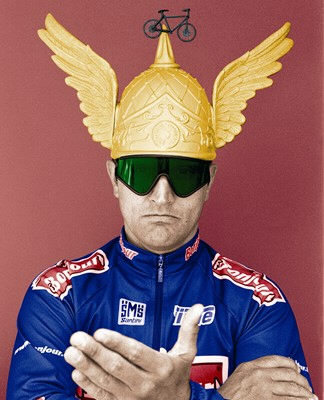
The Bicycle Men ***
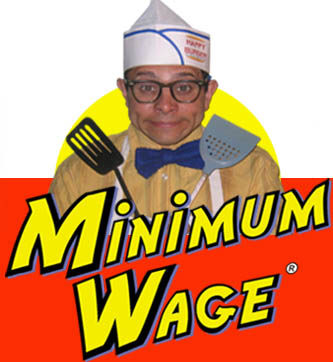
Minimum Wage: Blue Code Ringo ***
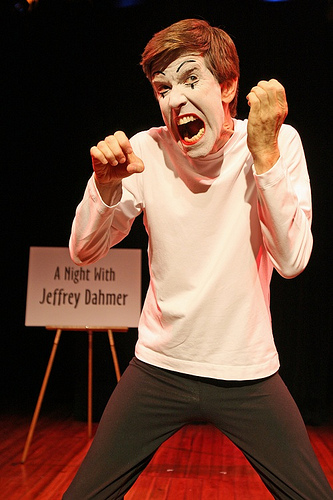
Billy the Mime ***
If You See Something, Say Something ***
Broken Hands ***
The Day The Universe Came Closer ***
Happy Sauce ***
24 Is 10: The Best Of The 24 Hour Plays (8/27/06 Show) ***
24 Is 10: The Best Of The 24 Hour Plays (8/26/06 Show) ***
Danny Boy ***
Thought Prints—Starring Torkova, The Postal Prestidigitator ***
Women and the Trojan Horse ***
24 Is 10: The Best Of The 24 Hour Plays (8/22/06 Show) *** (Note: For background
on the 24 Is 10 series, read this review first.)
I Was Tom Cruise **½
Grace **½
24 Is 10: The Best Of The 24 Hour Plays (8/24/06 Show) **½
Billy The Mountain And Other American Card Tricks **½
Walmartopia **½
The Deepest Play Ever: The Catharsis of Pathos **½
I Want To Be Musashi: A Clown Samurai Fantasy **½
Open House **½
Chess **½
How 2 Men Got On In The World **½
Red Herring **½
Vote McOwskey! **½
The Prostitute of Reverie Valley **½
Dis/Appearing **½
Diving Normal **½
Lulu **½
Hermanas **½
Band Geeks: A Halftime Musical **½
Only a Lad **½
In Transit **½
The Blue Martini **½
Romancing The Terrorist: Tajiki Nights **½
The Pumpkin Pie Show: La Petite Mortes **½
House **½
Perfect Harmony **½
Full House **½
Blue Balls: In & Out Of Uniform With The NYPD **½
58!: A Comedy About Bike Messengessengering **
Sunday Night Live: On Tour! **
Reviews of all 65 of these shows follow. To read them, please click a title above; browse through the first 33 reviews below; or click to browse through Reviews 34-65.
I've assigned all reviewed shows one to four stars, using the following rating system:
**** = Transcendently Great
*** = Solid & Worth Seeing
** = Unless Your Relatives Are in the Cast, Think Twice
* = "I Wanted to Kill Myself"
Please keep in mind that these reviews will have been written in a hurry. If you spot any factual errors, please don't hesitate to let me know by emailing hy@hyreviews.com. I'm always happy to make corrections and updates.
|
Rating: **** |
|
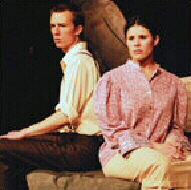
Tuesdays & Sundays is a small, perfect gem.
Beautifully written and sensitively performed by Daniel Arnold and Medina Hahn, the show portrays a young love that starts out sweet, funny, and tender...and then goes terribly wrong. Based on the true story of two Canadian teens in 1887, the 45-minute play employs a simple set and spare, carefully chosen words that carry the impact of great poetry. By its end, it's virtually impossible to not be moved by this unforgettable production.
Arnold and Hahn are Canadians who met while in college. While they aren't involved romantically, they have a special chemistry; and over the course of performing their show more than 100 times around the world, they've honed it to a dazzling sparkle.
Partly as a result, Tuesdays & Sundays isn't only the best show of this year's festival, but the best show I've ever seen at FringeNYC.
Arnold and Hahn are currently working on several other projects. Anyone who's experienced them is eagerly awaiting what they create next.
Meanwhile (as I mention in the Festival Highlights section), it would be wonderful if some producer was smart enough to match this diamond of a play with one or two other amazing shorts for the sake of creating a NYC commercial run.
|
Rating: ***½ |
|
Excerpted from Wikipedia.com:
Joseph Pujol (June 1,
1857-1945) was famous in Victorian times for his remarkable control of
the abdominal muscles, which enabled him to break wind at will. His stage
name Le Pétomane combines the
French verb péter,
to fart, with the -mane maniac suffix...In English, a translation
might yield the fart maniac.
His profession can also be referred to as a Flatulist
or a Fartiste.
His special ability (began with) sucking up water from a pan into his rectum
and then projecting it through his anus up to several yards. He then found
that he could suck in air as well. Although a baker by profession, Pujol
decided to try his talent on the stage and debuted in Marseille
in 1887. Some of the highlights...involved playing a flute through a rubber
tube in his anus, and farting sound effects of cannon fire and thunderstorms.
He could also blow out a candle from several yards away.
After his act proved successful, he proceeded to Paris (and) the Moulin
Rouge in 1892.
This fascinating fellow was the biggest attraction at the Moulin Rouge for seven years, outdrawing even such superstars of the period as Sarah Bernhardt; and his odd ability is played for hilarious effect in this comedic musical.
Almost everything about The Fartiste demonstrates keen attention to quality and detail. The orchestra, songs, dancing, costumes, and direction are terrific; and many in the cast are of Broadway calibre.
In fact, Nick Wyman (Moulin Rouge emcee Aristide Bruant) is a Broadway veteran, playing Thenardier for six years in Les Miserables, acting in the original cast of Phantom of the Opera, and performing in My Fair Lady with Rex Harrison; Jim Corti (talent booker Charles Zidler) portrayed Harry Houdini in Ragtime; and Lyn Philistine (Moulin Rouge fading star & temptress La Goulue) was in the revival of Gypsy with Bernadette Peters. Wyman, Corti, and Philistine all provide wonderfully memorable performances.
The heart of the show, however, is the team of actor Kevin Kraft as Joseph Pujol and comedian Steven Scott as, effectively, Pujol's sphincter. While Kraft performs a perfect series of poses and facial expressions to represent Pujol executing his special brand of art, Scott casually stands in a corner before a microphone and brilliantly creates all the sound effects in the show—including a variety of screamingly funny nuanced farts—using only his voice. The result is the best comedy duo since Penn & Teller.
Book writer Charles Schulman also creates some fine lines leveraging the absurd nature of Pujol's talent. For example, early on Pujol says, "My goal is to make art an essential part of the word fart." When in negotiations with Pujol for a performing contract, his booker explains, "I've hired plenty of assholes who could sing, but this would be my first singing asshole." And when later faced with contractual problems, Pujol declares, "No one owns the wind."
In addition, Michael Roberts provides some terrific songs. Some sample lyrics (sung beautifully by Rebecca Kupka as Mrs. Pujol):
What kind of man is he, with this bizarre faculty?
My dream man was born of tradition
With a good job and staid disposition
But the man that I love works in a crouching position.
What a way to be...
What kind of man is he, with his bizarre ability?
My dream man was from the good classes
With dark vested suit and perhaps wired glasses
But the man that I love works in audible gasses.
What strange company.
What kind of man is he?
There's a serious problem with the production, though, and that's its story structure. While it seems obvious that the show should focus on Pujol, he doesn't even appear for the first 15 minutes (with the opening instead devoted to two song-and-dance numbers about the Moulin Rouge). Worse, we never learn much about Pujol as a person, and he's provided with no credible or compelling character arc. In addition, there's virtually no conflict in the story, external or internal; and no great stakes are established to create dramatic tension.
There's also lots of material that could use tightening, including superfluous songs and non-essential characters. For example, one of the folks hanging out at the Moulin Rouge is Henri de Toulouse-Lautrec, who's one of the most interesting artists of his era, but virtually nothing is done with him in the script. He should either be cut or entirely rethought.
And while I adore the performances of both Nick Wyman and Jim Corti, is there a reason their two characters—both cynical showmen who manage talent—can't be combined into one? Alternatively, if a choice is made to hang onto both actors (which I'd favor), each of their characters needs to be made entirely distinct and essential to the story.
In a nutshell, the show needs to become less rambling, more emotionally compelling, and much more focused on Pujol.
Such gaping story flaws would normally be fatal. This production is so excellent in every other respect, however, that the problems could probably be fixed with a few months of rewrites.
I hope the producers push at improving this delightful show. With a genuinely strong book, The Fartiste could be a prime candidate for a long NYC commercial run.
|
Rating: ***½ |
|
This comedy explores the life of girls, and then of women, with exceptional honesty, sensitivity, and wisdom.
The first half of the show is a series of vignettes revolving around a Girl Scouts camp, and its sharp observations about the passages of girls while discovering themselves is often quite funny. Some sample lines:
Deep
questions: How do you embarrass an archeologist? Give him a tampon
and ask him what period it's from.
It's not TV: HBO = Horrible Body Odor.
Identifying
a lesbian: Do you like Susan Dey?
Credo:
When we feel elated, we want to shake it like we mean it.
Deep
truths: Beautiful models have their own language.
Proposed
real-world Girl Scout medal: The Realizing That Childhood Kinda
Sucks Badge.
Girl Scout advice: Close your mouths and open your ears.
However, what makes the play extra special is its second half, in which it leaps ahead 15 years and shows us the gals as adults. There's a huge gap between their early dreams and subsequent lives as grown-ups...and yet, in odd ways, their Girl Scout training proves to be far from irrelevant.
The quality of the script reflects the background of its writers, Andrea Berloff (screenwriter of the recent Hollywood feature film World Trade Center) and Mona Mansour (former member of the acclaimed Chicago improv company The Groundlings). But Berloff & Mansour do more than deliver professionalism; they speak from their memories and their hearts, and use laughs to deliver a genuinely moving experience.
Also notable are the cast's four actresses: Barbara Pitts, Deb Heinig, Nisi Sturgis, and Karen Zippler. They all play a multitude of roles, and are all wonderful.
For a commercial run, the main changes I'd suggest are upping the production values (e.g., the current set pieces are cute, but reflect a low budget); and, as excellent as the current actresses are, replacing one or two with sharp brand-name celebrities...because the script is strong enough to attract stars.
It's painfully rare to find a show that conveys the perspective of women with insight and wit. Girl Scouts of America merits a long life post-Fringe.
|
Rating: ***½ |
|
In a society built upon male competition, who really wins? And how does this aggressive behavior jibe with the lessons of cooperation we're taught as children, such as "never swim alone"?
These issues are explored with both humor and drama via a series of verbal boxing matches between two young businessmen. Acting as referee is a young woman in a bathing suit—who is more than she seems.
Daniel MacIvor's play, which he both wrote and directed, starts out simply and builds in power as it goes along. The snappy dialogue often requires split-second timing to be effective. Fortunately, the actors who tackled this show for its original FringeNYC run in 1999 returned for this Alumni production, and are all exceptional. Douglas Dickerman and John Maria portray the dueling men with the grace of skilled athletes; and Susan Louise O'Connor is simply magical as she manages to evoke emotions in us by a subtle look or slight turn of a shoulder.
To say much more could give away surprises, so I'll just add that I was very happy to see Never Swim Alone listed among the FringeNYC shows to be extended. If you missed this play during the festival, be sure to catch it in September.
|
5. Todd Robbins' Carnival Knowledge
Rating: ***½ |
|
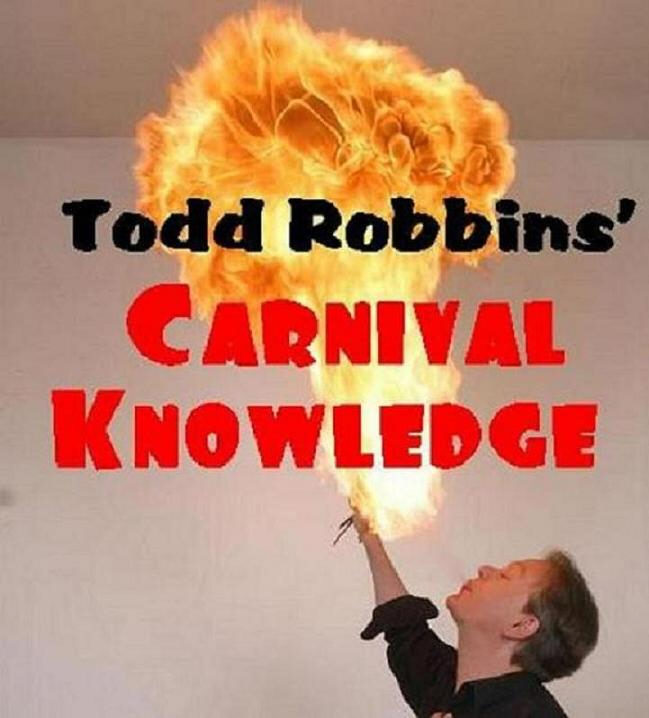
There used to be over 300 big-tent sideshows that traveled all over this country, crammed with, in the words of Todd Robbins, "unusual people doing astonishing things." Sadly, there are now only two classic carnivals left—Ward Hall's Worlds of Wonder, which is a touring show; and our own Coney Island's Sideshows by the Seashore.
Todd Robbins is a veteran Coney performer at the top of his profession; and is also the dean of a Coney Sideshow School where he attempts to keep this fading American tradition alive.
As Robbins explains in his show, "There are only about 400 fire eaters in the world...and that's an entry level sideshow skill. There are also only around 200 human blockheads, hammering six-inch nails into the nose; 40 to 50 sword swallowers; and just four or five people who eat light bulbs."
Over the course of his show, Robbins performs all these classic stunts, as well as such other feats as walking & jumping on glass, and creating some magical transformations. In addition, he includes two memorable women who perform other types of acts, such as twisting into impossible shapes and expertly juggling swords.
What makes this production really special, though, is Robbins' terrific showmanship, and his deep knowledge of and love for his work. For example, while demonstrating sword swallowing, he explains that to learn this skill first requires months of practice with a flattened wire hanger simply to get over the body's natural gag reflex; and it takes a year to master inserting actual swords.
Similarly, while he munches on a light bulb, Robbins explains part of what makes the stunt work is that after his "light snack," he quaffs a special liquid—which, for comedic effect, he keeps in a Windex bottle and dyes a Windex shade of blue. According to Robbins, "I've eaten over 4,000 light bulbs so far; but if I ever get sick, it'll probably be cancer from the blue dye."
With the exception of a spectacular illusion at the end, none of the feats performed in Robbins' show are magic tricks. However, they're very specialized techniques that require a great deal of time and patience to learn...not to mention a crazy kind of courage.
Todd Robbins is the real deal, and a wonderful talker and entertainer to boot. Carnival Knowledge is a lovely opportunity to see the best of a once-thriving art form designed to do nothing more than fill audiences with amazement and wonder.
After highly recommending this production to friends, some have expressed the following concern: "But I'm not a Samuel Beckett expert. Will I be able to enjoy the show?"
In a word, absolutely. All you need to know going in is that Beckett wrote somewhat downbeat plays.
If you're familiar with Beckett's writing, though, you'll derive extra pleasure from the periodic wry in-jokes
Much of the joy of Lost Works comes from its surprises. Therefore, I'll simply add that among the highlights is a puppet show titled Happy Happy Bunny Visits Sad Sad Owl; and a bit so brilliant that it'll burn itself into your brain (and yes, you'll definitely know it when you see it...).
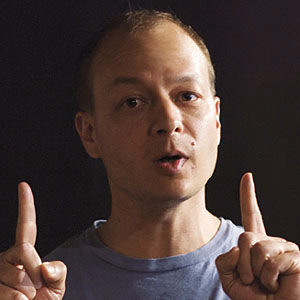
Lost Works comes from the Neo-Futurists, a Chicago-based group that includes Greg Allen, Ben Schneider, and Danny Thompson (i.e., the writer/performers of this production). If after seeing the show you crave more, know that the Neo-Futurists also have a New York division, and the NYC team is currently performing Too Much Light Makes the Baby Go Blind every Friday and Saturday at 10:30 pm at The Kraine Theatre. For details, please click here.
|
Rating: *** |
|
Self-described as "an entertainment with French overtones," this show by a highly skilled comedy troupe (Dave Lewman, Mark Nutter, Joe Liss, and John Rubano) debuted at FringeNYC in 2004 and is one of the most-loved productions in the festival's history, delighting anyone who enjoys silly accents and even sillier songs.
For example, when offering a lullaby to a baby (portrayed by a frighteningly cute doll), the main character sings, "You can pray but no one will hear/God is the product of ignorance and fear/It's best that you know." He continues by advising the babe on topics ranging from love to the after-life to pets: "And our pets don't care what we feel/Starve them and presto! They'll eat you for a meal/It's best that you know..."
And if you're wondering "Why a bicycle?", this is also covered in song: "Fast as lightning and so much more, it's a traveling metaphor..."
The first 20 minutes are uniformly wonderful, and the entire show's filled with whacky characters and situations. However, there's only a slim overarching story (involving a musical promise early on to the audience that we'll become "Not the person you were before/Not a jerk or a stinking bore"), and the myriad of skits aren't equally funny, so the energy level eventually goes up and down depending on the quality of the material being trotted out.
As for what deep truth you'll garner from it all, the main character says it best: "Such a lesson I've learned today/ What it is, I cannot say/Thanks for coming, now go away."
|
8. Minimum Wage: Blue Code Ringo
Rating: *** |
|
To fully appreciate this show, one should ideally first see Perfect Harmony, a play in this year's festival that's about singing a cappella brilliantly...but doesn't.
In contrast, Minimum Wage is the real deal. Listening to the harmonic singing of the five-member troupe—Charlie LaGreca, Jeff LaGreca, Suzanne Slade, William Caleo, and Tony Daussant—is sheer pleasure.
Further, these marvelous singers are also talented comedic actors—and delightful as "Happy Burger" employees at a training center reminiscent of McDonald's Hamburger U. They work their magic on the audience before the show even begins, handling out paper chef hats, plastic burgers, job applications, and other fun trinkets.
This party atmosphere only revs up when the show begins. The theme song, Minimum Wage (written by co-stars Charlie and Jeff LaGreca, and Sean Altman) , is deliciously tuneful, and features such witty observations about their characters' prospects as "You start at the bottom, work up to the middle."
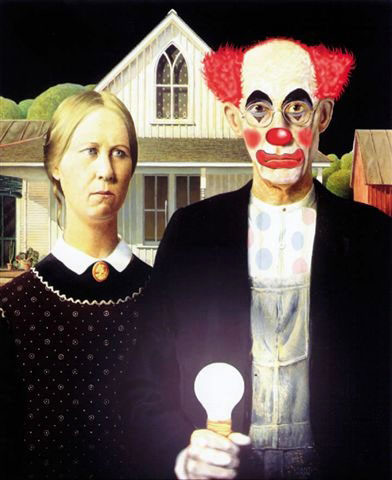
Soon afterwards, we're introduced to Happy Burger spokesman Kooky the Clown, who replies to a few letters from his fans. One child asks, "Do you like boy clowns or girl clowns?" Kooky replies, "Well actually, I'm very confused right now. I'm terrified of intimacy of any kind with anyone. There's so much trust involved. I don't know if I'm able or willing to share myself—or if anyone would have me. I do know that I don't want to die alone....Whoo ha ha ha ha!"
Another child's letter asks, "If you were a color, what sort of color would you be?" Kooky responds, "I have a tumor. I'm not sure if it's benign or not. I won't get the tests back for a couple of weeks. I'm in a lot of pain....Whoo ha ha ha ha!"
In a word, hilarious. For its first 20 minutes, Minimum Wage is one of the most energetic and joyful shows in FringeNYC history.
Unfortunately, the narrative loses its way after that. While the performers and singing are wonderful throughout, the songs start digressing into non-burger realms, which diminishes focus. Worse, no actual story materializes, which gives the show a random feeling...and ultimately hurts its energy.
But if the LaGreca brothers wrote a more disciplined, classically structured book, and some new songs as fine as their theme to go with it, there's no reason this show couldn't enjoy a long commercial run. In every other way, Minimum Wage is great.
|
Rating: *** |
|
If you're typical, you cringe with disgust at the word mime.
That's largely due to a barrage of awful street performers who believed they were being creative by pretending to be trapped in boxes.
If you think about it, though, what mime
does is boil a situation down to its essential elements, and then express
those elements in a manner that's instantly and universally understood.
And that's really what art is all about.
That's also what Billy the Mime does, often brilliantly. His production
consists of a dozen vignettes, each of which tells a story (ranging from
small to epic) in mere minutes.
The titles of these mini-shows include A Romance, Van Gogh, San Francisco Nights—1977, Close to You: Karen Carpenter, World War II, The Priest and the Alter Boy, The Abortion, Terry Schiavo—Adieu, A Day Called 9/11, and The Clown and the Beautiful Woman.
Regarding the latter, there was some extra drama on the performance I attended on August 17th. Billy reappeared dressed as a clown, walked into the audience, and invited a young woman to come on stage with him. He then proceeded to lead her through several generations of dance routines within a few minutes. She was up for the challenge, and everyone was enthralled by the two of them doing the show-stopping number from Pulp Fiction—when the lovely volunteer danced one step too far backwards and flew off the stage in a spectacular arc. (Most stages have wings, but the one at the Player's Theatre simply cuts off at its borders.) Very fortunately, her head missed hitting a number of metallic objects by just about an inch; and thanks to martial arts training, she knew how to handle a fall. In fact, after about 30 seconds of deep concern from the audience, and especially Billy, she bounced back up and pluckily continued the dance routine. This brave woman (whose name is Miranda) is my pick for Fringe audience hero of the festival.
Despite the mishap, though, Billy received at standing ovation at the end; and it was well-deserved.
|
10. If You See Something, Say Something
Rating: *** |
|
Ignore the awful title, which has nothing to do with the production. (What was she thinking...?) This autobiographical show by Elna Baker is among the best-written and best-performed at this year's FringeNYC.
Baker's a comedienne and storyteller who's only 24 years old but is as smooth on stage as most veterans. She's also unusual for being one of the few Mormon comics in New York.
Baker starts off by explaining Mormons are thought of as people who say no. And while it's true she doesn't partake of drugs, alcohol, nicotine, or sex, Baker tries to make up for that by saying yes to most of the other opportunities thrown her way.
It's for this reason she loves Manhattan, which she describes as a "grid of possibilities." Walk down one block, you may encounter an amazing chocolate store; walk down another, you could meet the love of your life.
Baker's show is mostly about the ways in which she's said yes to life, which range from crashing business conventions to nab free merchandise, to pretending to be a movie extra so she can hang out on the set and get made over, to hiring a sexist con artist she meets on the street as a personal trainer, to dating an atheist.
The tale of the latter is the most dramatic, as it raises a key conflict—what do you do when your heart says yes but your beliefs tell you to say no? You may not agree with Baker's decisions, but they're grist for thought and discussion. In fact, this is a good show to see with a date, as you'll probably want to argue about it afterwards.
But most importantly, Baker will make you laugh a lot. HBO Comedy Development's Dan Gregor said of a previous production, "Elna Baker tells stories with so much effortless charm and natural humor that you almost forget she's on a stage and you're not just sharing a beer. Endearing, funny, and unique—I think everyone in the audience was secretly hoping her next story would include them."
Agreed. Smart, witty, and superbly delivered, this is the finest one-woman show of the festival.
|
Rating: *** |
|
A revival of one of the earliest shows to run at FringeNYC (back in 1997), Americana Absurdum in many ways embodies the spirit of the festival for its past 10 years: wildly energetic, frenetic and silly, politically satiric, and leaning heavily to the left.
The production consists of two one-act plays by Brian Parks: Vomit and Roses, about a family-run funeral home combatting a corporate takeover; and Wolverine Dream, about the legal circus that ensures after a pilot intentionally crashes an airplane. The plays are linked by their approach: rapid-fire dialogue, film-like quick cutting between short scenes, and irreverence.
Regarding the latter, what might have been considered daring when the plays were written (Vomit and Roses was first produced in 1994) struck me as rather tame in the wake of recent real-life political absurdities, or when compared to the light-handed but razor-sharp satire of Jon Stewart's The Daily Show.
That said, performing in this show is virtually an Olympic event; and much of the pleasure of the production is in watching the enthusiastic cast demonstrate itself to be more than up to the task. Therefore, kudos to (in alphabetical order) David Calvitto, Brian Dykstra, Leslie Farrell, Peter Jacobson, Jody Lambert, Matt Oberg, Paul Urcioli, Eva van Dok, and Nancy Walsh; and to director John Clancy for putting all the elements together.
|
www.myspace.com/brokenhandsfringenyc
Rating: *** |
|
In 2004, Sorrel Tomlinson produced Dog Sees God, one of the finest shows to ever grace FringeNYC. Tomlinson's name has come to mean quality; and so it's no surprise that her production this year is another festival highlight.
Set in the South and East ends of London in the 1950s, a period of crushing poverty and organized crime, Broken Hands is about a slow-witted, monosyllabic boxer named Mick who's a force of nature when he punches; his brother George, who manages Mick and his money, but ultimately isn't very good at either job; and Scratch, a local mob boss.
The performances in this play are jaw-dropping. Cory Grant trained and works in New York, but you'd never know it from his superb UK accent for Mick. Even more impressive, though, is how Grant—who in his acting headshot appears a sweet-faced boy—continually conveys a sense of tremendous destructive power, as if he's a coiled spring ready to be released at any moment...and lord help whoever happens to be standing in the way.
Tom Souhrada, who actually is from the UK, is equally impressive as Scratch. While a lesser actor would make this villain come off as a cartoon, Souhrada plays him with finesse, bringing out such nuances as Scratch's pettiness and vanity, and the quite mundane nature of his evil...which makes every scene Souhrada appears in all the more believable and chilling.
Eric Miller is excellent as George, a character struggling between his loyalty to his brother and his obligations to the mob. And supporting actors Chuck Bradley and Constance Zaytoun are fine as Scratch's assistants.
This is one of the very best dramatic casts in the festival. And it's well worth catching the play just to experience the marvelous characters and delicious performances.
Kudos are also due to Marc Weitz for his taut direction; Jay Ryan for the smart set and moody, film noir lighting; and Charlotte Fleck for her dialect coaching, which clearly paid off.
As for the script by Moby Pomerance, it's intelligent, thoughtful, and suspenseful on a scene-by-scene basis. That said, it focuses on surface events at the expense of a resonant overall premise. If any rewriting is considered, I'd suggest injecting clearer arcs for both George and Mick, who currently don't seem to change much internally over the course of the story. And I'd also suggest adjustments to the ending to make it more deeply satisfying (i.e., well beyond the level of crime melodrama). The current script is by no means bad; but I'd love to see it achieve the full potential of this very promising production.
|
Rating: *** |
|
Set at the 1960 World Chess Championship in Moscow, this crackling two-man play by Dimitri Raitzin is about a lot more than chess. Here's an excerpt of some dialogue between reigning champ Mikhail Botvinnik and his young challenger Mikhail Tal as they do battle over a board:
Tal: What's more important than proving that you are the best?
Botvinnik: Staying alive.
Tal:
What are you talking about?
Botvinnik: Stalin wanted a Soviet world champion. He wanted to send
America and the rest of the world a message: The country that can produce
the world chess champion will ultimately outsmart, outthink and outmaneuver
everybody. (chuckling) But imagine his luck—the
best players in the country are Jews.
Me, Keres, Bronshtein, Levenfish, Averbach, we could've had a minyan at the Soviet championships every year. Stalin wasn't happy about it, he didn't trust Jews. In those days, Jews would just disappear. Doctors, generals, actors, even chess players. People went missing so often that if a friend disappeared, everyone would just roll their eyes at each other. BUT! Know what one person would never disappear? The World Chess Champion. That was your one sure ticket, for you and your family. So yes, I wanted everyone to know I was the best. But I needed to stay alive, to save my wife and kids. (pause) Ever wonder how you would play with a gun to your head?
Tal: Exactly like I always play. The better player should always win.
Botvinnik: Tal, chess is not about mating the king. It's about defeating the person.
And that's exactly what these two brilliant men set out to do, as they probe each other's weaknesses using both chess pieces and verbal jabs.
Actor Robert J. D'Amato is especially effective as Botvinnik, a champion comfortable in his skin; and Daniel Hendricks Simon does a fine job portraying Tal as a brash genius ready to conquer the world.
Most of this 45-minute production is gripping. I had a problem with the rhythms of the show not quite matching up with the ending, but that may be a matter of personal taste.
This is Dimitri Raitzin's first play. Here's hoping he writes many more that are just as smart and thought-provoking.
If you'd like to learn about the real Mikhail Botvinnik, click here; and to read about Mikhail Tal, click here.
|
www.myspace.com/freetobefriends
Rating: *** |
|
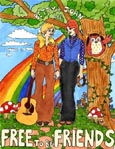
This time-trip back to the "progressive 1970s" spoofs children's TV shows such as Free To Be You And Me and The Magic Garden...while simultaneously taking tough jabs at political correctness and the special brand of intolerance practiced by the oppressed. The latter comes close to turning this into an anti-Fringe show...which makes its inclusion in this 10th Anniversary festival a special treat.
On a set decorated with paper cutout flowers, mushrooms, butterflies, and pretty skunks (that presumably really smell sweet but have just been misunderstood), the show's two female hosts proudly proclaim their lesbianism while singing about nonviolence and niceness. A prime example is this song:
Everybody loves pancakes,
Pancakes, pancakes, pancakes,
Strawberry, blueberry, buttermilk too,
We shouldn't be in Vietnam.
Pancakes, pancakes, Vietnam,
One of these things is clearly wrong.
One thing I can say for sure
The wrong thing isn't pancakes!
Because...
Everybody loves pancakes pancakes
Pancakes, pancakes, pancakes, pancakes,
Apple, peach, or chocolate chip,
What is Nixon thinking?
Pancakes!
Other ditties performed during this 45-minute mindbender include Boys & Girls Are Different in the Pants, It's Okay To Rage, and It's Great To Be A Lesbian In 1972.
The hosts are played with wry verve by the extremely talented comedic actresses Julie Klausner and Sue Galloway. Also hilarious is Neil Casey as the voice of an owl named Shylock who the gals treat horribly just because he's a man—until they push too far, the masks fall away, and everything changes.
If you're open to the tough satire of this show—honed by the rough-and-tumble comedy style of the Upright Citizens Brigade Theatre, where this production was developed—you're sure to have a good time.
And in any event, you're likely to leave humming the Pancakes song...
|
15. The Day The Universe Came Closer
Rating: *** |
|
This inventive one-man show from writer/performer Hiram Pines challenges how we see and think about everything in our lives. For example, the show begins as follows:
Two people can be on
opposite sides of the planet and feel together, or in each other's arms
and feel worlds apart. How close I am to those I love is determined by
how I feel about them. Why would the universe be any different? And what
if the universe has feelings for me? And you? Why not?...
The light from a star has traveled 17.3 light years to reach Earth. But
where is the object of the image that I see? On the surface of my eye?
I see the ground from an airplane 36,000 feet above the Earths surface. It's out there. We meet it when the plane lands.
But when we see the stars, they're not out there; were not credited with being able to see millions upon millions upon millions of miles into the distance. Why not?
Ten feet, 36,000 feet, 93 million miles? Where do you draw the line? I don't. I just call it the day the universe came closer.
Shifting from outer space, Pines asks us to reconsider the most mundane objects by asking "Where do rectangles come from?" They don't exist anywhere in nature; and yet we surround ourselves with them, endlessly creating rectangles via magazines, boxes, tables, rooms, city blocks...even the computer screen you're using to read this. Pines' answer:
Rectangles come from...inside us! Deep inside us. And they come out and they say, "I'm a rectangle. Do something with me! Unless you make something with me, I can't grow. And I want to grow..."
We're so in love with rectangles that we punctuate our travels with constant reminders. Every door, doorway, hallway a rectangle. And did you know each and every time you pass through a rectangle, it transmits secret little signals to your brain: "Be rectangle. Make rectangle. Breed rectangle children..."
By presenting us with these mind-benders, Pines forces us to reconsider everyday perspectives, and to see and feel in new ways.
This is actually a large part of the appeal of classic science fiction. And Pines' show reminded me of old pulp stories I love...such as a tale in which we learn the universe is expanding because it's fleeing our planet and its virus of human life; or another in which the Earth is revealed to be a giant egg, and ultimately cracks open to give birth to a spectacular spacebird.
To hold fast to comfortable assumptions is one of the most dangerous things anybody can do. Pines' show insists we question everything: the absurdity of the Earth spinning on its axis without tossing us off its surface; whether we're really different from water; whether we aren't a form of plant that converts sunshine into happiness; and how we should define life itself.
The production isn't perfect; it's a bit too repetitive in places, and Pines isn't a professional actor (though he has an intensely eccentric quality that somewhat makes up for that). Still, if you attend with an open mind, this show will give you thoughts and perspectives that may end up taking permanent residence in your brain...right alongside your inner rectangles.
|
Rating: *** |
|
Imagine that your name is Mr. Happy; that you have a tremendous crush on a girl but are beneath her notice, and so decide to "show my love in sauce form;" and that the result is the most delicious sauce ever created.
You might think this would bring nothing but joy to everyone. But that would be awfully naive...
That's the premise of Happy Sauce, a comedy by playwright and co-star Benjamin Lewis (in the photo above, the fella at the far right with the long cigarette). The first third of this 70-minute production is high-energy and hilarious. After that, the script starts running out of ideas and hits story lags; but this tale of greed, addiction, and love is still enjoyable overall.
A large part of what makes the show work is its exceptionally funny Boston cast. Jonathan Randell Silver, who plays Mr. Happy, has the bushy hair and plastic face of a Gene Wilder, coupled with the savvy attitude of Seth Green—a very winning combination that's likely to propel Silver to a great career.
Also fabulous is Mary Wiseman, who appears equally comfortable being super-sexy to garner the audience's lust and making an ass of herself to snare laughs (a strategy that's proven to be pure magic on such hits as Friends...).
The other actors are Matt Citron, Gabe Levey, and (as previously mentioned) Benjamin Lewis, who are all delightful. Even better, everyone seems very comfortable and generous with each other. Kudos to director Matt Dickson for helping create such lovely chemistry—as well as ensuring the gags are pulled off with split-second timing.
As far as I know, this is the best non-musical comedic cast in the festival. If you're up for a good time, go see these actors strut their sauce.
|
17. 24 Is 10: The Best Of The 24 Hour Plays (8/27/06 Show)
Rating: *** |
|
The final show in the festival's 24 Is 10 series—which showcased favorite short plays from the past decade that were written and performed from scratch in 24 hours—was also the best of the four I caught (out of five). The plays performed on this evening were:
Two Worlds: Created: 9/9/02. Writer: Christopher Shinn. Director: Nela Wagman. 2006 Cast: Maggie Bofill (Nina), Havilland Stillwell (Carla), Aasif Mandvi (Tyler), Connor Ratliff (Fred).
Vaudeville, Population Two: Created: 12/16/01: Writer: Will Eno. Director: Ken Rus Schmoll. 2006 Cast: Christina Kirk (One), Kristen Kosmas (Two).
Play With Faun: Created: 3/31/03. Writer: Jeff Whitty. Director: Diana Basmajian. 2006 Cast: Sarah Eliana Bisman (Jane), J. C. Vasquez (Roger), Tor Ekeland (Nat), Diane DeCoste (Margaret), Lawrence Feeney (Faun), Brian Soliwoda (Stan).
Sleeping City: Created: 2/02. Writer: John Belluso. Director: Pippin Parker. 2006 Cast: Robert S. LaVelle (Professor Brine), Jonathan Rossetti (Ben), Aynsley Moorhouse (Lois/Doris), David Abeles (Otto).
Three Guys and a Brenda: Created: 3/15/04. Writer: Adam Bock. Director: Moira Boag. 2006 Cast: Julie Shavers (Bob), Nadia Bowers (Joe), Jama Williamson (Randall), Tami Dixon (Brenda).
Most cutting was Vaudeville, Population Two, a dark comedy in which a pregnant woman dying of uterine cancer—while wearing a large Mexican hat and carrying a plastic pumpkinhead—is made light of by another woman with much more mundane concerns. Towards the end, the latter cheerfully looks out from the stage and declares, "You're going to lose everything. No matter how afraid you are, you can't be afraid enough." This elicited somewhat nervous laughter from the audience; the kind that acknowledges the truth of the joke. What more can one ask of any play?
Also enjoyable were Two Worlds, which makes clear one woman's dunce is another's prince; Sleeping City, a cute farce involving academics, wheelchairs, and prostitution; and Play With Faun, about a wandering sex beast.
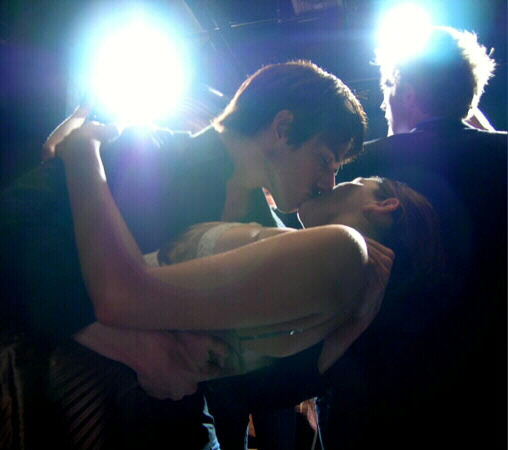
Most sweet, however, was Three Guys and a Brenda, in which an all-woman cast portrays three male construction workers and their tough female boss. The banter about how to deal with women is hilarious, with Nadia Bowers a standout among a uniformly superb group of actresses. And the ending, which involves a kiss, is simply delicious.
The last line of this play—and, given its scheduling, of the entire festival—was "I gave my girlfriend a flat stone I found on the side of the road." What's left unstated is that sometimes such spontaneous discoveries turn out to be gems...which is the great pleasure of this series.
|
18. 24 Is 10: The Best Of The 24 Hour Plays (8/26/06 Show)
Rating: *** |
|
This fourth (of five) shows in the festival's 24 Is 10 series—which showcased favorite short plays from the past decade that were written and performed from scratch in 24 hours—featured the following five mostly comedic mini-productions:
Harbingers of Turpitude: Created: 2/7/99. Writer: Robin Goldwasser. Director: Mark Armstrong. 2006 Cast: Chris Van Strander (Steve-O), Alessandra Ziviani (Gabby), Brian J. Soliwoda (Loomis), Mary Cross (Miss Ohio).
And I Dance, And I Dance: Created: 8/19/02: Writer: Chris Cerasco. Director: Jim Jacobson. 2006 Cast: Nicole Leach (Ida Willet), Gbenga Akinnagbe (Turnip), Michaela Murphy (Mrs. Foster), Christopher McCutchen (Jacob Hatwell).
Mars Has Never Been This Close: Created: 9/15/03. Writer: Warren Leight. Director: Andrew McCarthy. 2006 Cast: Michael Mastro (Chris), Pablo Schreiber (Sam), Michael Davis (Gregory), Chris Gartin (Mark), Andre Royo (Earl).
Altitude Sickness: Created: 1996. Writers: Nicholas Locke and Hugh Adlington. Director: Amanda Charlton. 2006 Cast: John Gleeson Connolly (Mouse), Chris Anderson (Georgie Boy), Samantha Phillips (Mum), Elliotte Crowell (Sandra).
K, X, Z, & V: Created: 8/6/00. Writer: Ian Williams. Director: Mary Kate Burke. 2006 Cast: Sean Williams (Trent), Seth Shelden (James), Maggie Hoffman (Madeline), Katherine Creel (Sheila), Greg Miller (Boss).
Harbingers of Turpitude is a dark parody of improv comics, including their typical anger, messy relationships, and proud self-destructiveness. Some of the shots go wide of the mark, but others hit dead center...and the latter are the ones that make the audience most uncomfortable.
Altitude Sickness is a goofy skit about cowardly mountain-climbers scaling the floor of a living room. K, X, Z, & V is an entertaining comedic look at the process of naming a new drug, which apparently involves such rules as "It should sound like it's from the future" and "It must have a K, X, Z, or V in the name."
The highlight of the evening, however, is Mars Has Never Been Closer, which takes place at a wedding reception table at which all the invited minorities—blacks, Jews, gays—have been seated together. Warren Leight.'s dialogue is witty and sharp, and the acting by the uniformly superb cast—with Broadway veteran Michael Mastro among the standouts—is an utter joy.
|
Rating: *** |
|
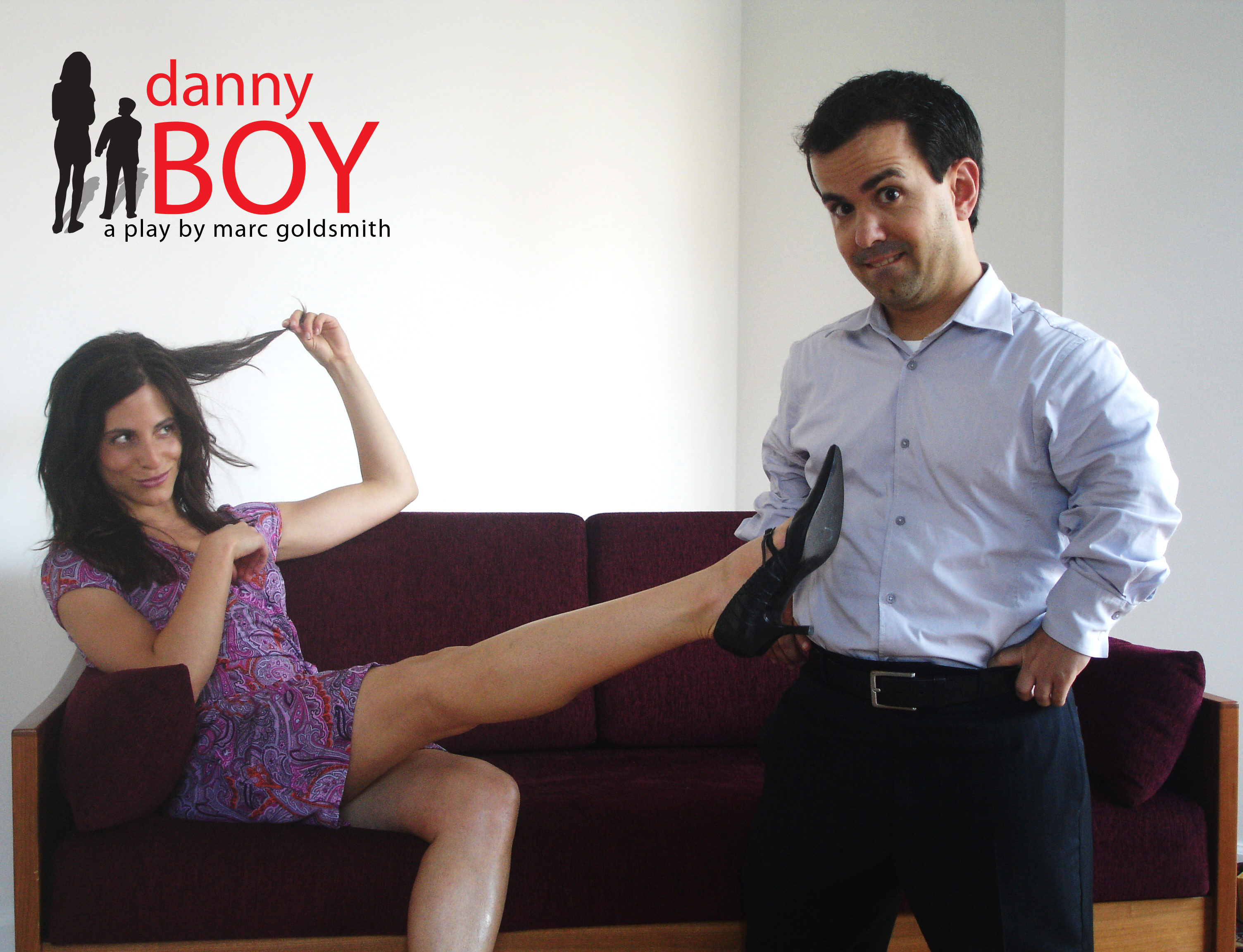
Danny Bloch, a four-foot tall Jew living in New York (and played just right by Stephen Jutras) kicks off this comedy by revealing his innermost desire: "Get laid. By a real hot girl. For free."
Danny also has a related wish: Persuading that attractive woman to accompany him to his upcoming class reunion: As he explains to his roommate Gabe, "I'm not going to the reunion with the same girlfriend—i.e., my right hand—that I had when I was 10."
The beer-guzzling Gabe (deftly acted by Troy Hall as the loveable slacker every guy's been friends with in college) urges Danny to take a chance and ask out an officemate: "Make your Shabbas dinner for her. Before you know it, she's sampling your matzoh balls."
Meanwhile, Gabe's girlfriend Dori (played with stylish verve by Deshja Driggs-Hall) offers such loving support as, "Before giving Danny advice, why don't you focus on your own f*cked up life?" Gabe replies to Danny, "You see why I couldn't resist her..." Actually, Gabe and Dori make no sense as a couple—which is especially amusing for anyone who reads the playbill, because in real life the actors are married to each other.
These three characters are a delight; but the comedy really revs up when sexy officemate Allison enters the picture. Coming from a wealthy family who can give her anything, Allison craves being able to give to someone else, and she's turned on by Danny's intense need for her—and by his willingness to accommodate her every request for role-playing in bed (e.g., dressing as an elf, or pretending to be Toulouse-Lautrec). Sarah Schoenberg starts off portraying Allison as a hyperactive cartoon, which is off-putting; but as Allison's behavior becomes increasingly extreme, Schoenberg is more comfortable letting actions speak for her, and the performance becomes more relaxed and natural—and ultimately hilarious.
The show is also greatly aided by the smart dialogue of playwright Marc Goldsmith—e.g., when asked "Normal? What's normal?", Danny replies without hesitation, "Being tall enough to ride Space Mountain." And when Allison demands to know why Danny didn't ask her to a Little People of American convention, he responds, "Because you'd have invited them all over to act out Dorothy's first night in Munchkin Land." The 105-minute script would flow better if trimmed to 90 minutes—e.g., there are a couple of long scenes with Danny's mother that are mostly dreadful, and both the scenes and the mother should probably be cut. Aside from such lags, though, Danny Boy is one of the wittiest shows of the festival...and Goldsmith is a writer to keep an eye on.
Kudos are also due to director Christopher Goodrich for helping put together the terrific cast, and creating a fine balance of sharp comedic timing and dramatic moments. And a final nod must go again to Stephen Jutras, whose believable performance as Danny is key to making this production work so well.
|
Rating: *** |
|
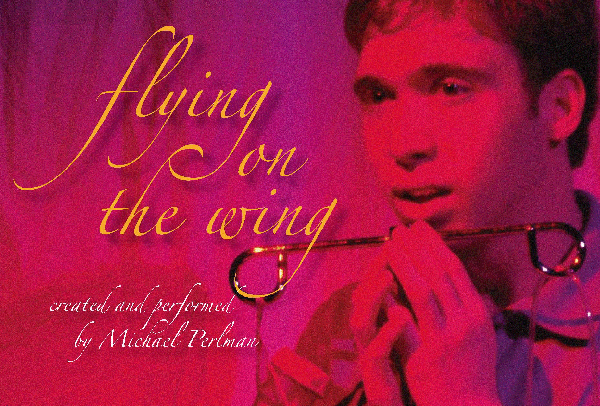
This production begins in the dark, as a figure with a shadowy wing-span and a raspy, haunting voice declares himself to be the archangel Michael, sending shivers up our spines.
And then the lights go up to reveal Michael Perlman—a four-foot tall man who's standing on boxes and holding out a cape to simulate a visual presence matching his hoarse theatrical voice.
The tension between the physical challenges we're handed, how people perceive us, and who we truly are is a running theme of this unusual autobiographical show.
In a series of dream-like vignettes, Perlman paints a portrait of his suffering from a horrific illness called Stickler's Syndrome; dealing with a series of doctors and agonizing operations that challenge his will to live; his mom and grandparents lending him the strength to endure; his great love of musicals; and a dawning realization that he's gay.
Perlman is touching throughout, but especially poignant when he interacts with dolls and action figures, who become surrogates for his own small, frail body.
There's a fine line between being nakedly honest and self-indulgent, and so there are times when the production drags. But overall, this is a memorable and unique show about, in Perlman's own words, "a vertically-challenged arthritic hearing-impaired homosexual young man and his world of musicals, Playmobils, divine intervention, and Play-Doh."
|
Torkova, The Postal Prestidigitator
Rating: *** |
|
Torkova is a charmer.
He appears in a puff of smoke, adorned in the absurd cape and crown pictured above. But he quickly drops the outfit (explaining "that's really not my style") in favor of plain clothes, a red bow-tie, and a very laid-back attitude. This is clever of him, as he both allays our skepticism and gains our affection in one stroke.
Torkova (which, he's quick to tell us disarmingly, "is just my stage name") first relates some anecdotes about how he developed psychic abilities during his day job at the post office. These are mundane enough to almost be believable.
He then proceeds to some rather impressive demonstrations of his "powers." The stunts include correctly identifying the zip code of one audience member, the birthday of another, the card someone selects from a deck, the word someone picks from a page in a book, and so on.
One can have suspicions about how some of these magic tricks are performed—for example, when audience members purchase tickets in advance, their names can potentially be researched via online services such as Google before the show begins—but this takes nothing away from the smooth skill with which Torkova simulates psychic mastery.
There are also some feats—such as predicting all the serial numbers on a random dollar bill collected from the audience—for which I couldn't even begin to guess the technique used.
Of course, there's a slightly nerdy quality to virtually any magic show, and that's the case here as well. Non-kids are unlikely to leave the show feeling they've been deeply touched or had a life-altering experience.
But if you'd care to see a shrewd and very likeable performer baffle you with his mystical achievements, Torkova's act is worth catching.
|
22. Women and the Trojan Horse
www.nytheatre.com/nytheatre/fpreview_intl2.htm
Rating: *** |
|
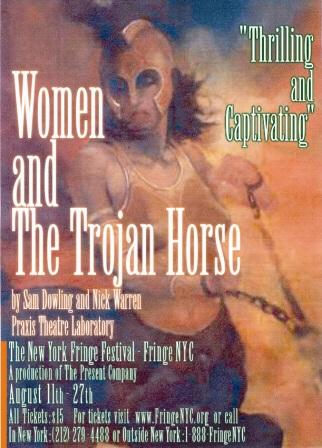
The word improv is usually linked with comedy. But this show demonstrates the power of a rarer form of improvisation focused on the other theatrical mask...classic tragedy.
The show is additionally special because its Irish acting troupe is entirely female; and the play concerns itself with characters usually relegated to the background—the royal women of Troy during the war with Greece that culminated in Troy's destruction.
The production challenges expectations before it even begins, as you're steered away from the theatre to an adjacent lobby, leaving audience members standing around and clueless about what will happen next.
And then the women appear, alternately flirting with and making cutting remarks to various audience members, and quarrelling with themselves. There's the iron-willed Hecuba, Queen of Troy (Maria Straw-Cinar); her disturbed daughter Cassandra (Rachel Sutton), an all-too-accurate oracle who no one cares to believe; Andromache (Carol Brophy), Hecuba's common stock daughter-in-law; Hera (Caroilin Callery), the goddess who champions women; and of course Helen of Troy (Maggie Gallagher), who's officially the reason for the war...though the actual motivations behind the conflict are more complex.
The audience has a chance to interact with each woman one-on-one, making this tale of centuries past feel current and real; and only then is everyone led to the theatre to sit and experience the rest of the drama.
What follows isn't entirely improvised, but a blend of prepared material (created from a series of improv sessions with the actresses turned into a script by Sam Dowling and Nick Warren), and dialogue that the performers make up on the spot. The result is a play that's at time rambling and difficult to follow, but can also be riveting in its spontaneity and the "in the moment" feelings it lays bare on stage.
Improvisation expert Mikal Reich once said, "Improv tragedy leads with the heart, not the head." That's evident from this emotionally charged production, which is unique and worth experiencing.
|
23. 24 Is 10: The Best Of The 24 Hour Plays (8/22/06 Show)
Rating: *** |
|
This was the first show in the festival's 24 Is 10 series, which revived some of the best short plays from the past decade that were written and performed from scratch in 24 hours.
The original productions were born from the 24 Hour Plays program in which a writer meets with his or her creative team at 8:00 pm to discuss ideas. The scribe is then left alone to spend the night churning out a script. In the morning, a director, actors, and other team members gather to begin figuring out how to mount the play...and start rehearsing. At around 6:00 pm, there's a tech run-through. And at 8:00 pm that evening—i.e., 24 hours from when the process began—the show is performed on stage before an eager audience.
This might seem a nutty way to make art; but the time pressure can sometimes spur the creation of spontaneous work that has a wonderfully organic energy to it.
For this year's FringeNYC, 25 short plays from the past 10 years of the program were selected to be performed again over the course of five evenings.
Whenever possible, the actors from the original productions were used for the revivals. To help maintain freshness, though, rehearsals for these remounts were limited to eight hours or less.
In between plays, the wonderful musical team of Matthew Brookshire (vocals and guitar) and Erika Kapin (violin) entertained the audience as sets were changed.
The latter four shows featured the 20 top picks of the program's producers. However, this first evening showcased the top five choices of audience members (via voting on the Web). These plays, which fell heavily into the category of absurdist comedy, were as follows:
Tobias, Angel of Heaven: Created: 3/15/04. Writer: Connor Ratliff. Director: Daisy Walker. 2006 Cast: muMs (Toby), Sami Plotkin (G-d), Nicole Kempskie (Narrator), Jennifer Ostrega (A Simple Woman), Doug Howe (A Simple Man).
Dream State, or The Subconscious Burlesque: Created: 10/29/01: Writer: Angel David. Director: Eli Gonda. 2006 Cast: Michael Davis (Bill, etc), Robert "Fitz" Fitzsimmons (Brad, etc.), Brice Gaillard (Brice, etc.), Jocelyn O'Neil (Jocelyn, etc.).
The Bus Stop: Created: 5/7/05. Writer: Candido Tirado. Director: Ian Morgan. 2006 Cast: Amelia Fowler (Dee), Julie Wright (Sarah), Brent Cox (Brent), Vanessa Davis (Vanessa).
Crisco: Created: 12/9/00. Writer: Julie Stark. Director: Moira Boag. 2006 Cast: Brian Soliwoda (Joey Jr.), Samantha Phillips (Mona), Matthew Kinney (Vinny Jr.), Leigh Ann Larkin (Arteria).
The Rumor: Created: 6/3/02. Writer: Dan Kois. Director: Joe Ward. 2006 Cast: Garret Savage (Chuck Bonner), Sean Williams (Chris Tingley), Bradford Olson (Larry Wakefield), Nancy Wu (PR Flack), Tor Ekeland (Reporter 1), Brice Gaillard (Reporter 2).
The most notable shorts were the ones that opened and closed the show.
The Rumor is set at a press conference in which a baseball player vehemently denies being ambidextrous—i.e., able to pitch with his left hand as well as with his right.
Garret Savage, Sean Williams, and Bradford Olson are all delightful as macho athletes discussing a topic that clearly causes them embarrassment.
And the highlight of the piece is when a reporter asking hard questions appears from "Both Hands Magazine..."
But my favorite play of the show—and in some ways of the entire series—is a small masterpiece of chaotic comedy titled Tobias, Angel of Heaven. It begins with a large, clumsy angel—portrayed by the screamingly funny actor muMs—who screws up one time too many and is called into God's office. The Lord declares She's had enough (yes, God is a woman), and she decides to obliterate Tobias. Upon hearing this, Tobias collapses into tears...and the pathetic sight so depresses God that She kills Herself. Having offed the Creator of Everything, Tobias moves through time and space to find peace—and then things start to get silly...
Tobias, Angel of Heaven beautifully demonstrates the need for the 24-Hour Play series. Without the excuse of pulling an all-nighter, who would dare write a work this insanely hilarious?
|
Rating: **½ |
|
Despite the gimmicky title (which at first blush seems to scream "I want to be the festival's next Matt & Ben"), this 90-minute play is surprisingly sombre—sort of a cross between The Prince and the Pauper and Faust.
It begins with a normal guy named Frank who's having problems with his marriage. While heading home, he accidentally walks into a film shoot for a Tom Cruise movie...only to be mistaken for a Cruise stand-in due to his similar body type.
This leads to Tom Cruise slowly befriending Frank, and to eventually making a startling suggestion: switch bodies and lives, so that Cruise can relax out of the spotlight and Frank can enjoy its perks.
The rest of the play explores the repercussions of Frank's decision.
It's a clever high concept, albeit a familiar one—see, for example, the brilliant 1966 film Seconds directed by John Frankenheimer and starring Rock Hudson.
Also, the script fails to sufficiently convey the nuances of both the joys and agonies of being a modern superstar.
That said, the choice of Tom Cruise for subject is shrewd...and not only for marketing reasons. During a party, Joaquin Phoenix tells Cruise, "Sure, I'm a celebrity. But you're the celebrity." That's a sharp observation; and it sets Cruise up as a uniquely larger-than-life figure who suffers for our sins.
What's best about this show, however, is the terrific performance of Jeff Berg as Cruise. Not only does Berg pull off a surface resemblance (though he isn't a Cruise look-alike in real life), Berg both hilariously and convincingly mimics Cruise's body language, poses, expressions, and—most impressively—Cruise's aura of constant energy and charisma.
Also notable is Amy Flanagan, who's quite fine as Katie Holmes. Indeed, the scenes between Berg and Flanagan are among the most deliciously memorable in the show.
If the script was rewritten to spend less time on the uncompelling domestic issues of Frank, and instead focused on a genuinely revealing portrayal of what it means to be a celebrity in the 21st Century, this could become a fabulous play.
Meanwhile, the show semi-works thanks to its various dark twists, and to the enjoyable impersonations of Berg and Flanagan.
|
www.myspace.com/sweet_tea_creek
Rating: **½ |
|
Grace is a series of short one-acts that portray women dealing with life's fundamental issues—dating, marriage, pregnancy, aging, death.
The mini-stories by Shannon Thomason & Sara Thigpenby are essentially unrelated, and so the show rises and falls with the quality of the particular vignette being performed...most of which are pretty good. However, the production overall would be much stronger if the tales built upon each other instead of simply being presented as part of an anthology.
That said, a notable unifying element is the excellent cast—in alphabetical order, Kathleen Brown, Jennifer Leigh Jones, Beth Ann Leone, John Long, Marcella Anise Smith, Karen Sternberg, and Brit Whittle. Kudos goes to director Melanie Ashley for gathering these talents, and for helping them create a lovely spectrum of comedy and drama.
The other thing that makes Grace work are stray moments—eliciting a laugh, a sigh, or thoughtful silence. While the show as a whole doesn't quite hang together, these random special moments create a glow around the entire production.
|
www.theinflictionofcruelty.com
Rating: **½ |
|
The title of this drama comes from a Bertrand Russell observation: "The infliction of cruelty with a good conscience is a delight to moralists. That is why they invented Hell."
That's a dynamite quote; and a great foundation for creating an emotional powerhouse of a play.
Unfortunately, this 100-minute production is full of quotations, but little emotion.
The characters consist of three brothers, a sister, and the girlfriend of the youngest brother. The siblings have been to the best of schools—and for some unfathomable reason, the playwrights decide to demonstrate this via endless allusions to the worlds of literature, psychology, religion, etc. The continual quotations that stream forth appear to have been assembled almost randomly, and they offer no insight on the story or anything else. Instead, the conversations come across as aca-babble. (Imagine Mr. Spock in a Star Trek episode, replace photon torpedoes with Emily Dickinson, and you've got the picture...)
It was at times painful to watch the cast struggle to make the ridiculously pretentious dialogue sound credible. That said, all five actors—Pawel Szajda, Aimée DeShayes', Holter Graham, Justin Barrett, and Elizabeth Van Meter—are very strong, with Szajda and DeShayes' especially compelling as the younger couple; and they all help elevate the play.
Also aiding the production is the elegant set by Jerome Martin, which tells you everything you really need to know about these characters' backgrounds at a glance.
Further, beneath the conceptualizing is an actual beating heart of a story. It's barely visible in Act 1, but begins emerging in Act 2; and by the end of the play, a vital point is made: If you inflict cruelty, you're likely to get at least as hurt as your target.
If the writers replaced their excerpts from Bartlett's with the thoughts and feelings of real people, this production could grow into something quite special.
|
27. 24 Is 10: The Best Of The 24 Hour Plays (8/24/06 Show)
Rating: **½ |
|
This third (of five) shows in the festival's 24 Is 10 series—which showcased favorite short plays from the past decade that were written and performed from scratch in 24 hours—featured the following five mini-productions:
Karla Says: Created: 12/5/05. Writer: Mac Rogers. Director: Eli Gonda. 2006 Cast: Karla Mosley (Karla), Chris Guilmet (Chris), Kelley O'Donnell (Kelley).
The Woman: Created: Summer 2004: Writer: Michael John Garces. Director: Alex Correia. 2006 Cast: Brian J. Carter (S), Maggie Bofill (M), Andres Munar (A).
Vikings!: Created: 3/28/99. Writer: Greta Billinger. Director: Chris Dippel. 2006 Cast: Brent Cox (1), Dean Strober (2), Brian Soliwoda (3), Michael Casselli (4), Kathleen Choe (Flower Vendor).
Poor Bob: Created: 12/5/05. Writer: Elizabeth Meriwether. Director: Mark Armstrong. 2006 Cast: Will M. Rogers (Seymour), Elliotte Crowell (Kitty), Matthew Stadelmann (Noah), Patrick Heusinger (Bob).
A Weekend in Brazil: Created: 9/5/98. Writers: Ted Travelstead & Julie Wright. Director: Moira Boag. 2006 Cast: Matthew Kelty (Leslie), Abigail Gampel (Rebecca), Ian Brownell (Howard), Connor Ratliff (Stan), Samantha Phillips (Connie), Chris Kaminstein (Jesus).
These shorts are probably the most subtle, but also least-focused, of the five-show series. Their themes run from seduction and infidelity to yearning for companionship and love. None entirely work, but they offer notable moments. For example, a woman remains gagged through most of Poor Bob; but she's freed when she accepts a journey with Atreyu of The Neverending Story...and finally admits to being a princess.
|
And Other American Card Tricks
Rating: **½ |
|
Billy the Mountain began as a 30-minute Frank Zappa song that debuted on tour in 1971 and on Zappa's album Just Another Band from L.A. in 1972. Like most of Zappa's work, it's whacky; and even more so because it's a parody of the rock opera format made popular by The Who's Tommy in 1969.
This FringeNYC musical is based on the same epic tale as the song, about a mountain named Billy and his wife Ethel, a tree, residing in California. Billy has two large caves that resemble eyes, and a cliff for a jaw that lifts up and down, puffing up dust and boulders. And he enjoys posing for picturesque postcards.
What sets events in motion is Billy receiving a royalty check for the postcards. Billy and Ethel decide to celebrate by taking a vacation in Las Vegas, and then New York City. But it turns out a mountain traveling cross-country can create a great deal of havoc, and this leads to Billy getting involved with the government, the media, and ultimately a superhero sent to stop him. As the moral of the story teaches us, however, "a mountain is something you don't want to f*ck with."
Considering its insane plot, the show would benefit from making the narrative easier to follow; and by giving us at least one or two characters we can like and relate to.
That said, this production is energetic and colorful. If you're seeking something different, there's nothing at the festival quite like Billy the Mountain.
|
Rating: **½ |
|
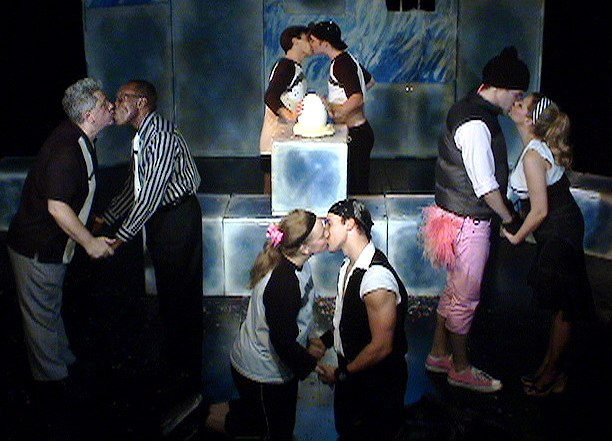
This play is based on true-life incidents of penguins in zoos who happen to have chosen a companion with whom they can't procreate being forced, via electric shocks, to break up with their lifelong mate in order to have sex with penguins able to bear children. This practice has spurred vehement protests from gay groups, who see it as a metaphor for a larger problem of human intolerance.
It's a terrific foundation for a play, and this charming comedy starts off very strong. Unfortunately, once the central idea is established, the script repeats it over and over in endless variations, as if the audience is too stupid to grasp it the first time. This 105-minute show would actually be much stronger if 45 minutes were cut out.
+Meanwhile, alleviating the tedious repetition is an excellent comedic cast. Especially fine are Stephen Hayes (Wendell), Anna Becker (Gomez), and Andrea Pettigrove (deliciously funny as Swedish penguin bombshell Dia).
Kudos also go to Michiko Kitayama and Tim Brown for designing a superb stage environment using pseudo blocks of ice and nifty trap doors. The set is so well done that it virtually becomes a starring character in the play.
|
Rating: **½ |
|
The playbill of Walmartopia begins with this mission statement: "Theater should address the profound inequality in our nation and in the world...to illuminate the most important issues facing our society."
This should ring alarm bells for two reasons:
Political propaganda seldom makes for good art, let alone an enjoyable musical.
To shed light on "the most important issues facing our society," the show targets...Wal-Mart?!?
Both of these concerns end up being valid. The script pounds relentlessly at Wal-Mart's flaws—overworking and underpayment of employees, failure to promote women, intolerance of nonconformity—at the expense of such fundamentals as compelling characters and a credible plot.
There's not even a nod to the positive aspects of the chain (e.g., broad selection, low prices, efficiency, convenience). Instead, at its end Walmartopia champions doing away with mass production and having us all grow our own food!
Despite its flat-out stupid story, though, Walmartopia provides interesting information about the unsavory aspects of Wal-Mart that lends the show gravitas. Also, the five-man band is fabulous, as is the music by Andrew Rohn—which, unlike the script, is layered, fresh, and pleasantly surprising.
The other element that aids the show is its large cast from Madison Wisconsin, which mostly isn't polished but is uniformly enthusiastic. That said, one standout is Kelly Richelle Murphy, who has a lovely singing voice, and as an actress brings charisma and neverending energy to each of the dozen or so roles she tackles. (And if that wasn't enough, she's also the show's costume designer!) This talented human dynamo should probably move to NYC or LA as soon as possible.
Other noteworthy troupe members include Kelly Kiorpes, an appealing redhead who grabs the spotlight with her high-energy singing and dancing; and Stefanie Resnick, one of the few cast members who resides in NYC.
So while this show succumbs to all the pitfalls of propaganda, you may still find yourself humming some of its songs and enjoying its performances.
|
Rating: **½ |
|
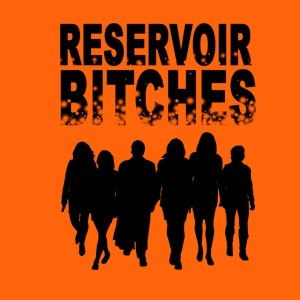
One of the most memorable moments in Quentin Tarantino's 1992 Reservoir Dogs is when code names are handed out to the macho robbers and Steve Buscemi vehemently protests at being assigned Mr. Pink.
No such problem exists in this fun parody written by Laura McGhee in which all the roles are played by women. Instead, one of the female criminals blurts out, "That's such a great color for you!" And the reply is: "I know, Miss Pink! I love it!" They do have a brief argument about the Miss, which "isn't very empowering;" but quickly agree to make it Ms.
The show is filled with such entertaining adjustments for gender. For example, to prove her courage, one criminal tells an anecdote about the time she was carrying a large amount of heroin when police happened to walk by with a drug-sniffing dog. Her bold solution was to remark to the cops, "The dog must be smelling me. I had my period this morning!"
Other noteworthy lines include:
Don't pussy out on
me! You're Pepper f*ckin' Anderson!
Domestic violence
is the #1 cause of homicide in this country.
Shortly
before several people are shot: My blood sugar is really low. I
get bitchy when I don't eat.
After
several people are shot: I need a moment to process this emotionally.
Shortly
before more people are shot: You don't need proof when you've got
female intuition.
After
someone's ear is cut off: Could you get my earring? It was an anniversary
present from my husband.
The gender gags are generally smart and thoughtful; and the uniformly fine actresses appear to be having a great time, enhancing the audience's own enjoyment.
On the down side, you need to be familiar with Reservoir Dogs and enjoy this play on the level of parody, as the story isn't very strong on its own. Also, it's effectively a one-joke show, which makes it somewhat strained at 70 minutes.
But if you're a Tarantino fan, or simply enjoy gender reversals, Reservoir Bitches is worth catching.
|
Rating: **½ |
|
Jessica Lynn Johnson's one-woman show opens with her back to the audience. Her character, named Carrie, is wearing sunglasses, a blank pantsuit with the word Juicy across the ass, and a tacky top exposing major cleavage. She's yammering on a cell phone, turning a moment to face us and hold up her finger to indicate "Give me just a minute," and then refocusing on her one-sided conversation—which involves arranging to take care of her very blonde hair before any black roots surface.
Finally, Carrie hangs up and says, "So sorry, have to stay beautiful, right?" She then looks around and comments on her surroundings...at which point we realize she's not speaking to us, but to a psychotherapist she's visiting for the first time: "Diplomas from Harvard and Cambridge! I envy a man who knows how to brandish name brands without being homo about it."
Carrie explains she's fine, but has come by at the insistence of female friends concerned about her staying home all day watching talk and reality shows...and developing some major "mood swings." Then again, their motives are suspect: "You can never trust what other women say, because we're each other's competition."
Carrie does admit to being shaken by a recent death of a loved one, though: "It was Tinkerbell, my chihuahua. She suffocated in my purse. Very upsetting. She was the perfect accessory; she went with everything."
As for her friends' concerns that she's become disconnected from reality, Carries notes, "The closest I want to get to the real world is MTV's version of it."
The latter actually becomes the hook for the rest of the show, as Carrie abruptly begins turning into the people she's been watching. For example, she first becomes a redneck on Jerry Springer who manhandles his wife: "I beat her 'cause she needs to be beat!"
After several minutes, Carrie returns to her old self—with the transition as quick as the flick of a TV remote—and resumes her patter mid-sentence, oblivious to what's happened. This pattern repeats until Johnson has cycled through about 10 television stereotypes, such as a drunken frat boy, a high-strung African-American who refers to herself as "black chocolate," and a porn star who declares, "If a guy jerking off to your picture isn't power, I don't know what is."
This is a clever gimmick, as it allows Johnson to show off her acting skills by playing wildly different characters back to back. The only problem is she hasn't crafted any of them with the care devoted to Carrie; the multiple personalities are one-note affairs with virtually nothing of interest to say. As a result, I began dreading each new persona and the accompanying vapid monologue.
Still, Johnson's seamless transition from Carrie to a different personality, and vice versa, is a continual treat. And Carrie remains a delight, saying such things as, "All I have to do is wear a tight skirt and make out with some girl at the bar and I can have any man in the room I want. That doesn't mean I'm a slut. I only do it when I'm drunk."
If Johnson made her other characters as much fun as Carrie, this would become a helluva show.
|
The Catharsis of Pathos
Rating: **½ |
|
This comedic takeoff on Bertolt Brecht's Mother Courage is set in 2067 A.D, a post-post-Apocalypse populated by zombies and devils and lots of ill-mannered behavior.
If you're familiar with Mother Courage, you'll enjoy this.
Otherwise, though, the parody doesn't really stand on its own, and for long stretches you're more likely to be confused than tickled.
Still, the costumes and props are clever (e.g., a gun's represented by a stick with the word rage on one side and pain on the other), the writing is mildly amusing, and the cast is solid—with Chinasa Ogbuagu (Mother LaMadre), Phillip Taratula (Narrator Time), and Boo Killebrew (retarded daughter KitKat) as standouts.
Please click the links below to jump directly to what you're after:
Introduction to FringeNYC
Shows That Sold Out Performances
Other Sites:
Copyright © 2006, 2007 Hy Bender
Email: hy@hyreviews.com